Sunday, October 23, 2016

Cyber Warfare

Cyberwarfare.  Everyone know that's the next big thing, but nobody seems to know how it will really play out.  (This is part of why I'd like to take some classes in computer science - to learn more about what's possible)

We know a bit about what we've seen so far.  Stuxnet.  The 2007 attack on EstoniaTitan Rain.  Criminals that use cyber attacks to get money - through ransomware, DDOS attacks, and more. I also know a little, very little about what's possible.  Like the ability to hack someone's vehicle.

Cyberattacks are odd, in that it's hard to say if an attack is state-sponsored or based on individual criminal behavior.  Attributing an attack to state is...difficult.  Which also makes it hard to determine how a state should respond.  Would a cyberattack be grounds for war?  Would it lead to a more conventional response?  At this point, there's a lot of uncertainty about it.

I want to point out a couple of things.  DDOS attacks, to me at least, are more of a minor annoyance than a real threat.  I wasn't aware of the recent attack until after the fact, for example, because I was at work and wasn't trying to access any of the sites affected.  For me, as long as I can wait anywhere from a couple of hours or more, it's not a big deal.  Yet criminals are apparently able to make money off of these, because businesses lose money the entire time the system is down. (These issues, btw, raise questions about whether we want political leaders who have a poor understanding of computer issues.  It does not seem uncommon for older and more established politicians, for example, to be uncomfortable with smart phones and other aspects of the internet.)

While I heartily recommend talking to someone with real expertise on these issues, I do want to make a few points.

First, given what I said about how little Friday's DDOS attack affected me personally, some attacks are not really effective if you're able to unplug.  This is worth pointing out, as there still are a number of people who haven't moved into the internet world completely.  Granted, most of them are a bit older...but in my current job I am repeatedly astounded at how many of my employees are not comfortable with or familiar with what I used to consider basic computing skills.  I've had to assist them with figuring out how to get information over the internet - whether using a website to get a company award, or information on their retirement plans, and more. 

I do wonder whether cyberattacks would be more problematic in another twenty or thirty years, as people who know how to do things the old way are no longer around.  (For example - when I was in the military we all learned how to read maps.  Nowadays, many people use the GPS on their phones to navigate.  If an attack took down GPS, how many people could navigate using a map?)  Or take the example I used earlier where someone hacked a car.  Older cars might be safer, since they don't have all the computer chips and whatnot inside. 

It also means that EPM attacks are a very, very serious concern...since it would shut down a LOT of things we've become dependent on.

The importance of the internet is also worth pointing out, though again we still have old technology (like radios) that we can fall back on if need be.

I'm posting this more to point out the very large question mark we all should have with regards to cyberattacks, then to provide any real answers.  I think/hope that most countries are taking steps to secure any critical infrastructure, and have fallback plans in place in case computer chips and technology fail.  I believe the Department of Defense has taken steps to create a Cyber Command, and this could well become another branch (Air, Land, Sea...and now Cyber?)


Presidential Election 2016

http://mobile.nytimes.com/2016/10/23/opinion/sunday/the-dangers-of-hillary-clinton.html?smid=tw-share&_r=0&referer=https://t.co/swZLfvqCfC

Nice to see something capture my opinion so very well.

Trade, Government Policy, and Economics

https://www.minnpost.com/politics-policy/2016/10/preserving-sweet-life-minnesota

This is the first article I've ever read that really explains the issues tied to government agricultural subsidies. 

Saturday, October 22, 2016

American National Strategy - Cont.

I discussed the rather conventional geopolitical scenario for the United States in my last post.  I wanted to discuss economics next.

Or rather, if we are talking about an existential threat, there's not a lot that we should truly be worried about.  But tanks can't fight if they don't have fuel.  People can't live if they can't get food.  And there's a lot more to security than just having a lot of tanks and planes and soldiers.

Economics - well.  I'm not an economist, and I recommend you take what I'm about to post with some skepticism, since I admit I am not an expert here.  (When I daydream, I sometimes imagine I was wealthy enough to just putz around taking classes in economics, computer science, and finance...and then blog here about any interesting intersectionality.  I don't want a degree in those fields, I just want to know them well enough to help build my understanding of the world we live in today.)

So anyways, there are two or three points I want to make about economics.  First, nations do compete for scarce resources.  Access to those resources may not quite count as an existential threat, or maybe it does.  I phrased it that way to make a point about how different countries view this issue.  One way of assessing our economic security is to see how capable we are of guaranteeing the resources we would need. (With regards to energy, for example, we have a somewhat mixed outlook.  We do have our own domestic energy supplies.  Oil, natural gas, etc.  Some of that has been aided by fracking, and where energy security fits in with environmental concerns is a debate worth having at some point.  But we are still a net consumer, not producer, of oil.  So even though we probably could tighten our belts and ration resources if need be, we would struggle to keep our current standard of living without external sources.  We are in a much better condition than Europe, however, and Russia's use of Gazprom in their foreign policy is something to pay attention to.) 

Btw, economic security isn't just about energy.  Or rare earth minerals, even.  It's also about the basics of food, water, and enough resources for a sustained wartime effort.  The US is in a good position, again, w/regards to food.  We are quite the breadbasket, after all.  I get a little fuzzy on exactly what is necessary here, but I do believe Athens lasted so long after their failed Sicilian Expedition in part because of their strong maritime trade-based economy.  And that it's worth paying attention to the debate on how effective the Anaconda Plan was during the Civil War.  There's also merit to those who point out that our enemies used very inexpensive IEDs to take out very expensive Strykers and other pieces of military equipment.  In a sustained effort, can we afford to keep spending millions of dollars on equipment that our enemies destroy using parts that only cost a couple hundred dollars?

Economic security, however, gets into tricky territory.  After all, our involvement with installing the shah in Iran was allegedly about oil security, and it rather backfired on us.

Second, I want to go into the importance of trade routes, and trade in general.  Given what's been going on in this election year, a lot of people are questioning the benefit of trade and globalization.  We have grown so interconnected, btw, that it's really hard to say who is dependent on what, and where.  That is, we have Toyota cars built in the United States.  American finished goods with subcomponents from China, Malaysia, Singapore, and more. 

Again, I want to emphasize that you should talk to a good economist if you're interested in the subject.  But I'll give a little anecdote that, oversimplified though it is, may be useful.

Picture the original independent farmstead.  The family living there grows their own food, weaves their own clothes, milks their own cows, builds their own houses with material from their own fields and nearby land.

Now picture a neighbor moves in close by.  The neighboring family has a field that isn't very good for planting, but is pretty good for pasturing cows.  So the second family decides to get a few more cows than they need for their own sake, and offers to sell the extra milk to their neighbors.  Those neighbors no longer need to keep their own cow, so maybe they sell the cow and turn the cow pasture into another field.  Now they're growing more corn or wheat or whatever than they need for themselves, so they can turn around and sell that to their neighbor.  Or take it to market. 

Trading that surplus benefits both families.  They're able to get more of what they need, they don't have to spend as much effort trying to do it all themselves, etc.  But trade also makes it harder to go back to true independence.  If disaster struck, the family that had sold their cow would have to invest in a new cow and turn a field back into pasture if they wanted to get their own milk again.

So anyways.  Trade is good, mostly.  But it leads to specialization and interdependence.  And when you throw in nationalism, elite gamemanship, imperialism, globalization and multi-national corporations then the benefits may go to one particular group more than the others (and hurt others more than they benefit by it.)

The third factor I wanted to discuss was trade routes.  Shipping, btw, is still one of the fastest and cheapest ways of getting material from point A to point B.  Basically you can fit a lot more product on a ship than you can on a train, plane, or truck.  You can't use trains and trucks to ship across the ocean, and planes just can't hold as much material.  So shipping lanes are pretty important.

Take a look at this map:

https://s-media-cache-ak0.pinimg.com/originals/d6/1e/bc/d61ebc19f39134862b5f8c91e39b2559.jpg

It kind of gives you a sense of the largest shipping routes and some key locations.  The Strait of Malacca, the Panama Canal, the Strait of Hormuz, and the Suez Canal are all areas where trade must either flow through a constricted area or take a very long way around.  Actually, here's a nice little article talking about 8 global choke points.  Primarily discussing the flow of oil, but more trade goods than just oil ship through these chokepoints.

If you pay attention to history and/or current events, most of these names should already be familiar.  I want to point to our history with Panama and the Panama Canal, though, because the transition from our control to Panama illustrates some strategic points.  Namely that we don't actually have to control these choke points, so long as we have the freedom to navigate through them.

This is part of why the South China Sea is so tense right now (the possibility of oil within the sea itself is also a factor).  We sail around to make a point of the freedom of the seas, China sees it as an infringement on their territory, and all it will take is one stupid hothead and a few leaders unable or unwilling to look weak and we could wind up in a war with China.  The thing of it is, though, that so long as everyone is able to sail through the Strait of Malacca (and so long as there is no unreasonable taxes or duties that effectively limit usage) it shouldn't actually matter to much who has nominal control.  I'm sure that betrays something about my own ignorance of the area...and perhaps it doesn't matter so much to us (given how far away we are), whereas to the small nations around there it could make a tremendous difference to their economy.

And, of course, there's always the fear that if China did control the straits and was hostile to the US, it would seriously impact our shipping.

Thursday, October 20, 2016

American National Strategy - Current Situation

On to the fun stuff, though where do I start?  I just spent a lot of time discussing the importance of the situation at hand, so I could start discussing economics, globalization, Syria, technological changes, nuclear weapons, or any other number of things.  And I'll probably get to those.  Eventually.

For now I want to start with the basics.  Geopolitics.  Let's start with existential threats.  Here's a map of the United States:

 Image result for map United States

The United States is in a pretty enviable position here.  The continental US has two large oceans to our east and west.  Our major neighbors are Canada and Mexico, neither of which is (currently) much of a threat.  People don't always realize just how much space we're talking about here, either.  I mean, you can drive across England in about 13 or 14 hours, which is almost as long as it takes an American to drive through Texas.

We get along pretty well with Canada (shared language and history), though our relationship with Mexico is a little more problematic. Actually, one of the worst case conventional scenarios I could imagine is a hostile Mexico allied with a large enemy.  A force like that could cross our border and drive straight up the middle.  Yes, I know, doesn't seem likely right now...but I think a core policy should be keeping our neighbors friendly.  Neutral at worst.  And we definitely don't want to push them into outright hostility. (A realist may point out that we could instead try to keep our neighbors weak.  Sort of like Richelieu and what came to be Germany.  I personally don't think it's a good idea, partly because even if they're weak they can ally with a larger hostile country, partly because you will probably fail eventually, partly because changing norms make it less acceptable today than back in Richelieu's day, but primarily because I don't think our strength is dependent on keeping others weak.  And if you believe in free trade, which is kind of a big question this year, you must admit that countries with strong economies make better trading partners. If we worked with Mexico to end the drug war, undercut the cartels, get the corrupting drug money out of Mexican politics, and basically did our bit to help Mexico grow then one side effect is they'd probably have fewer people trying to immigrate here illegally.)

So.  It wouldn't be easy to attack us directly.  Probably the only nations with a better geography are islands like the UK, Japan, and Australia.  Which is where the next bit comes in - population.

 
Rank Country Population % of Population
  World 7,256,490,011
1 China 1,367,485,388 18.84%
2 India 1,251,695,584 17.25%
3 United States 321,368,864 4.43%
9 Russia 142,423,773 1.96%
10 Japan 126,919,659 1.75%
11 Mexico 121,736,809 1.68%
12 Philippines 100,998,376 1.39%
16 Iran 81,824,270 1.13%
17 Germany 80,854,408 1.11%
18 Turkey 79,414,269 1.09%
21 France 66,553,766 0.92%
22 United Kingdom 64,088,222 0.88%
23 Italy 61,855,120 0.85%

Yes, China and India together  make up 36% of the world population.  They have a LOT of people.  China has four times our own population.

And we have twice as many as Russia.  Almost as much as Russia, Iran and the Philippines combined.  (Actually, I find this sort of comparison very interesting.  I didn't realize Japan had almost as many people as Russia.)  Population count isn't everything, of course.  Some countries are aging, others have too many  men and not enough women.  There are different education levels and different fitness levels.  Yet the population count does help give some perspective on what size military you can expect a nation to field. 

We, for example, have less than a half a percentage of our entire population in the armed forces.  And yet we still have a larger military than Russia (according to this site, Russia has the fourth largest military with 766,055 to our 1,400,000.  In 2014 they're also estimated to spend 4.5% of their GDP on defense spending, as opposed to our 3.5%.) 

Speaking of GDP, here's some world rankings:

Nation                    GDP (in billions)        Rank
United States           18,561.93                   1
China                        11,391.62                   2
Japan                          4,730.30                   3
Germany                     3,494.90                   4
India                             2,250.99                   7
Russia                         1,267.75                 12


So what does it all mean?  Well, if you don't count nukes, or cyberwarfare, or terrorism, or pandemics and large scale natural disasters, then we're pretty much unassailable on the continental United States. 

I hate saying that, and I keep trying to quality it further.  It feels like the kind of statement the world loves to prove wrong.  At the same time if I throw in too many exceptions it weakens the point - We're large both physically and demographically, we've got good geographic boundaries, and we have a strong economy.  We'd be really, really, hard to take on directly.

That's not the entire story, of course.  Just keep it in the back of your mind when I get into the next bit.
 

National Security Musings, Cont.

I want to get into the nitty gritty of strategy, but I do think there's a couple of points about human nature I should make first.


There does seem to be a universal (or almost entirely) universal desire for respect.  Fairness. Decency.  We can train ourselves out of it, teach ourselves that 'the world is not fair' and that 'this is just the way it is', but it's something that we lose because of life experiences and the choices we make.  It's not something natural.


Which is why universal human rights are so powerful.  It's not so much that the ideal matches reality, as that so long as reality fails at this...we are likely to see unrest and instability.  Sure, 9/10 people will put their heads down and get on with life, no matter what.  And yet there will always be that tenth troublemaker, that young person who hasn't had reality beat into them yet, or an old person who is too tired to care. 


We can argue about what should and shouldn't be considered a human right, about where these ideas came from, and more.  Later.  What I wanted to focus on the most, here, is that living up to these ideals says something powerful, too.  It says that you can lead a nation without arresting everyone who disagrees with you, or makes fun of you, or makes you the butt of a joke.  That you can successfully impose law and order without resorting to torture.  That such things are actually unnecessary to ruling, at all.


Which has certain implications - namely, that all the states who do engage in such behavior aren't doing it for reasons of state.  The state can survive without it.  Rather, all the rulers engaging in such behavior are doing it because they've confused their own self interest with the needs of the state


What that also means is that every time we fail to live up to our ideals, we show that we don't truly believe that we can succeed while staying true to our ideals.  That we don't think we can win without torture, or manipulating elections, or arresting those who disagree with us. (Kind of reminds me of an ex-boyfriend of mine, discussing 'Buy America' and Toyota.  What he basically said was that he would buy the best car, whoever made it.  And if that car wasn't American than we need to get our act together and start making the best car instead.  Win not by pulling down the competition, but by pushing ourselves to be better.  This, btw, is the exact opposite of what Donald Trump is doing.  He's not going to "Make America Great Again" by creating an environment where we have the best manufacturers.  Instead, he's going to do it by trying to make it harder for the competition to sell to us.  Granted, you can say other countries have been manipulating the system in their favor already.  This is another topic too long and complicated to get into right now, but I want to point out that we need challenged to be better and do better, to rise to the challenge.  Not to whine about what other countries are doing.)


During the Cold War that I've been writing about, you could argue that a lot of our actions were taken because we didn't truly believe in capitalism.  After all, if capitalism was the right path all we had to do was wait.  Other countries will figure it out, eventually.  Even if the very worst happened, if communism had swept the globe and capitalism had fallen by the wayside, if the beliefs were correct wouldn't they eventually have been resurrected?


The fear of communism, then, actually shows how little faith we have in our own system.  Just as the justifications for 'enhanced interrogation methods' reveal how little we actually believe in rights such as "no cruel and unusual punishment".  Sure, this was not applied to US citizens...but if we truly believe this is a right, then we should be practicing it 100%.  Not deciding it's wrong for US citizens and acceptable for terrorists. 


Ideals aren't something we're supposed to give up just because things get tough. 


Tuesday, October 18, 2016

National Strategy - Idealism

I want to talk about idealist vs. realist foreign policy, but I've kind of been scared to.  Or rather, I'm scared of the possible conclusions. 

How so?

Well...if we say that we should live up to our ideals, then what's to keep us from going around and trying to make everyone else do so as well?  "Become a capitalist democratic federal republic or we'll invade!"  (Which is essentially what Russia claims we do).

Then there's the problems at a strategic level.  Same problem we faced in a counterinsurgency.  If you try to be everywhere at once, you're going to be rather weak everywhere.  You won't be anywhere in sufficient strength to really make a difference (if your opposition is determined). 

It's also the same problem with tackling poverty, I think.  If some wealthy philanthropist decided to give all their money away equally, everyone would end up with such a small amount that it wouldn't make a difference.  Idealism may be great in theory...but how do you apply it to the real world dilemmas of our time? 

How do you apply idealism about human rights, say, consistently?  If Russia and China think we're not serious about human rights, it's hard to blame them...we've been so inconsistent.  (Though I think they believe human rights is just something we bring up to conceal a more selfish interest, rather than understanding that it's mostly genuine and the only inconsistency is that our realists don't feel it's worth risking our necks over.)

At the same time, idealism is actually pretty important.  It what's gives us a future worth fighting for.  A future TO fight for.  Head in the clouds and unrealistic though idealists may be, their the ones that actually make the world a different (and sometimes better) place.  Those who accept the world the way it is and learn to conform, realistic though they may be, are pretty much ensuring that the future is just like the present.  In all it's flaws.

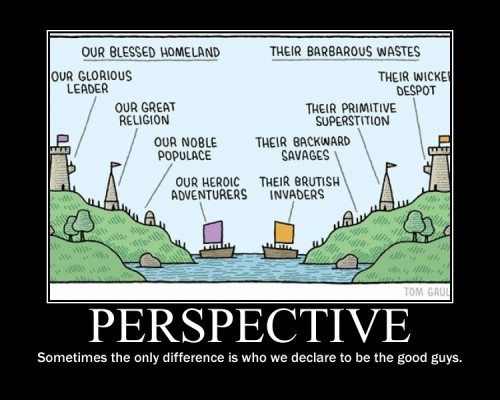
Not only that, Jim Collins noted that the corporations that lasted all had a greater purpose than simply 'to make money'.  In a similar fashion, I think most people need to feel like their group is about more than selfish survival.  That's what I like about this facebook meme:


Image result for meme tumblr "our heroic"

No matter what you call us vs them, you can see that each side is pretty much exactly the same.  That what you call them is just a matter of perspective.  Is this always true?  No, I don't think so.  Yet to reasonably say that our side is better, we have to be about something more than just "raison d'etat" 

Otherwise, well...a government is a government is a government, and it probably doesn't matter too much who is in charge so long as they make the trains run on time. (Since someone might misunderstand - I'm half joking here.  Later on I might go into different economic systems and what they mean, or discuss the development of nationalism, and how little it mattered in earlier time periods.  Right now it would be too much of a digression.)

That's enough for now.  I still haven't gotten to the heart of our own strategy, but this seems like a good stopping point for now.