https://twitter.com/TProphet/status/1239329139921833985?s=19
Showing posts with label National Security. Show all posts
Showing posts with label National Security. Show all posts
Sunday, March 15, 2020

Saturday, April 1, 2017
EMP Strikes
So if you want nightmares, or a reason to stay awake at night, go ahead and read the EMP Commission's report.
Came across this while doing research for a class paper, and since massive EMP strikes are one of my 'what's the worst thing that could happen to the United States' analysis I figured I'd share the horror.
Came across this while doing research for a class paper, and since massive EMP strikes are one of my 'what's the worst thing that could happen to the United States' analysis I figured I'd share the horror.
Friday, November 4, 2016
Fourth - American Ideals and Influences In Support Thereof
I wanted to go into more detail on the four goals I laid out, though I will take them in reverse order. That's because the interconnectedness makes more sense (to me, at least) this way.
So what direction do we want to influence the world in? Again, I think it's best to start with our foundation - the Declaration of Independence and the Constitution.
What's funny is that much of the Declaration is rather particular to the time and place where it was written. I don't think we need to go into all the offenses of King George. Instead, the most important (and most quoted) parts are from the second paragraph -
All men are created equal, currently in the broadest sense of the phrase. That is - men, women, transgender, asexual, lesbian, gay - they're all created equal and are endowed with certain rights. Unalienable rights, no less.
Such lofty words make our current politics seem so - small. Little. Petty. How can our leaders claim to believe we are all created equal when they manipulate the system? Clearly they don't think the opinions of certain people matter as much as others, clearly they do NOT think that we are all equal.
But I digress. It's an ideal, and not necessarily reality. But it's the kind of ideal that lifts you up, makes you feel more. Standing for this says something grand about us all.
And yet the Declaration is really rather vague on what those rights are. Other than "Life, Liberty and the Pursuit of Happiness" at least.
The Constitution does a little more, though I really recommend reading the Federalist and Anti-Federalist papers to get more of an understanding of the issues at the time, and what the Founding Fathers meant. I had the depressing experience of trying to explain why this matters to someone who just didn't care. For all that our patriots and politicians keep talking about the importance of the Constitution, how many of them can really discuss the Articles of Confederation? And why their experience with the Articles led to the Constitution? How many know that the Bill of Rights were not originally included. That they were written as a response to the debate (captured in the Federalist and Anti-Federalist papers) where various people expressed their concern that the new government would be too powerful? We had four years of debates about the Constitution before the Bill of Rights was added.
So what does that really mean for us, today? Particularly with regards to foreign policy?
I think it's best to consider a little bit of history, actually. I took a class in college on European History, from about the time of Napoleon on. What I remember most was realizing that almost every hot spot in the world today had it's roots in the colonial era. Boundaries were drawn with absolutely no regard for the ethnicity of the people inside them, so you had minorities ruling majorities (with the support of colonial powers.)
This has created quite the mess. The Kurds, for example, are one of the largest ethnic groups without a nation to call their own (and their neighbors are pretty nervous about ever letting them have a nation, since it would probably take chunks of their own territory). The thing is, I don't think the quest for national self-determination is simply because of nationalism.
And I don't mean that in a universal 'we are all human' way, either. Colonialism was disempowering because these outsiders weren't able to treat the local population with real respect. From calling grown men 'boys', to forcing them to learn a different language, to give up their own traditions and beliefs...colonial subjects were not treated as equals. It was often patronizing, demeaning, and insulting. China knows this all too well, since they suffered their century of humiliation. Japan saw what happened to China, that's part of why they had the Meiji Revolution.
Many ethnic groups seek self-determination because they don't believe they can maintain their way of life, their language, their religion, and their culture if they have anything less.
Unfortunately, this also runs counter to another trend - go big or go home. The United States is powerful in part because of how large we are (physically, demographically, economically). Russia, China, and India have similar strengths. Europe - well, if they unify they might be comparable, but each state on it's own? They're actually kind of small. (I remember my shock to realize you can drive across Germany in five or six hours. East to West. That's about the size of Indiana.)
Economically, the European powers are still very strong. But the world is balancing out, catching up. And when the rest of the world catches up, European states as individual nations are not going to be as powerful. (Was it Cheney who indicated Europe wasn't quite as important as it used to be? We don't often think that way, especially given our history with them. Don't be too hasty in assuming they don't matter though. Europe is still economically advanced and we do have a lot of commitments to them.)
This brings up another point, actually. The United States isn't in decline. It's just that as the world balances out, it feels like a decline. We're not as comparatively strong as we used to be. It's like being a billionaire in a world where more and more people are becoming millionaires and billionaires. You still have a lot of money, you just don't have quite as overwhelming an amount of it.
Go big or go home. I think that's part of what's going on with China's One Road project. An economic block stretching across Eurasia could be extremely powerful.
Except...what to do with all this diversity? All these groups that want to live their own way? If you plan to go big, you're going to live in a multi-ethnic, pluralistic society. Otherwise you will constantly have to waste resources, taking troops from one ethnicity and stationing them far away from home where they'll be loyal to the state and not to the (different) ethnicity around them. And if you pull those troops out (in case of war, for example) what's to keep the people living their from trying to break away in their absence?
Point is - human rights are essential for creating a large, multi-ethnic and peaceful society.
Our ideals, although we have not always lived up to them, mean we should treat every ethnic group, every nation, every culture with respect.
That doesn't mean we pretend we're okay with things we're not, even (or perhaps especially) when it seems less important than achieving some of our other goals. We ran into that dilemma in Afghanistan, particularly with the Afghan practice of bacha bazi.
In situations like that, it's like a person who's loved one is making bad life choices. You can tell them what you think, you can encourage them to do better, and you can cut off ties if that's what you need to do in order to make it clear you don't accept the behavior...but ultimately it's not about forcing them to do what you want. It's about being sincere in expressing your thoughts, and explaining why you think that way...and making choices about how to spend your time and resources based on your views.
With nations, of course, the tools are different. You can make a diplomatic statement condemning a practice. You can provide support for any attempt at changing a practice. You can reduce or cut off various ties (trade, military, diplomatic). You can place sanctions on them - not to force them to do what you want, but as an indication that your nation will not be associated with that behavior.
Note that I did not list regime change or war as one of the options here. For that, I again suggest just war theory.
So what direction do we want to influence the world in? Again, I think it's best to start with our foundation - the Declaration of Independence and the Constitution.
What's funny is that much of the Declaration is rather particular to the time and place where it was written. I don't think we need to go into all the offenses of King George. Instead, the most important (and most quoted) parts are from the second paragraph -
We hold these truths to be self-evident, that all men are created equal, that they are endowed by their Creator with certain unalienable Rights, that among these are Life, Liberty and the pursuit of Happiness. — That to secure these rights, Governments are instituted among Men, deriving their just powers from the consent of the governed, — That whenever any Form of Government becomes destructive of these ends, it is the Right of the People to alter or to abolish it, and to institute new Government, laying its foundation on such principles and organizing its powers in such form, as to them shall seem most likely to effect their Safety and Happiness.
All men are created equal, currently in the broadest sense of the phrase. That is - men, women, transgender, asexual, lesbian, gay - they're all created equal and are endowed with certain rights. Unalienable rights, no less.
Such lofty words make our current politics seem so - small. Little. Petty. How can our leaders claim to believe we are all created equal when they manipulate the system? Clearly they don't think the opinions of certain people matter as much as others, clearly they do NOT think that we are all equal.
But I digress. It's an ideal, and not necessarily reality. But it's the kind of ideal that lifts you up, makes you feel more. Standing for this says something grand about us all.
And yet the Declaration is really rather vague on what those rights are. Other than "Life, Liberty and the Pursuit of Happiness" at least.
The Constitution does a little more, though I really recommend reading the Federalist and Anti-Federalist papers to get more of an understanding of the issues at the time, and what the Founding Fathers meant. I had the depressing experience of trying to explain why this matters to someone who just didn't care. For all that our patriots and politicians keep talking about the importance of the Constitution, how many of them can really discuss the Articles of Confederation? And why their experience with the Articles led to the Constitution? How many know that the Bill of Rights were not originally included. That they were written as a response to the debate (captured in the Federalist and Anti-Federalist papers) where various people expressed their concern that the new government would be too powerful? We had four years of debates about the Constitution before the Bill of Rights was added.
So what does that really mean for us, today? Particularly with regards to foreign policy?
I think it's best to consider a little bit of history, actually. I took a class in college on European History, from about the time of Napoleon on. What I remember most was realizing that almost every hot spot in the world today had it's roots in the colonial era. Boundaries were drawn with absolutely no regard for the ethnicity of the people inside them, so you had minorities ruling majorities (with the support of colonial powers.)
This has created quite the mess. The Kurds, for example, are one of the largest ethnic groups without a nation to call their own (and their neighbors are pretty nervous about ever letting them have a nation, since it would probably take chunks of their own territory). The thing is, I don't think the quest for national self-determination is simply because of nationalism.
And I don't mean that in a universal 'we are all human' way, either. Colonialism was disempowering because these outsiders weren't able to treat the local population with real respect. From calling grown men 'boys', to forcing them to learn a different language, to give up their own traditions and beliefs...colonial subjects were not treated as equals. It was often patronizing, demeaning, and insulting. China knows this all too well, since they suffered their century of humiliation. Japan saw what happened to China, that's part of why they had the Meiji Revolution.
Many ethnic groups seek self-determination because they don't believe they can maintain their way of life, their language, their religion, and their culture if they have anything less.
Unfortunately, this also runs counter to another trend - go big or go home. The United States is powerful in part because of how large we are (physically, demographically, economically). Russia, China, and India have similar strengths. Europe - well, if they unify they might be comparable, but each state on it's own? They're actually kind of small. (I remember my shock to realize you can drive across Germany in five or six hours. East to West. That's about the size of Indiana.)
Economically, the European powers are still very strong. But the world is balancing out, catching up. And when the rest of the world catches up, European states as individual nations are not going to be as powerful. (Was it Cheney who indicated Europe wasn't quite as important as it used to be? We don't often think that way, especially given our history with them. Don't be too hasty in assuming they don't matter though. Europe is still economically advanced and we do have a lot of commitments to them.)
This brings up another point, actually. The United States isn't in decline. It's just that as the world balances out, it feels like a decline. We're not as comparatively strong as we used to be. It's like being a billionaire in a world where more and more people are becoming millionaires and billionaires. You still have a lot of money, you just don't have quite as overwhelming an amount of it.
Go big or go home. I think that's part of what's going on with China's One Road project. An economic block stretching across Eurasia could be extremely powerful.
Except...what to do with all this diversity? All these groups that want to live their own way? If you plan to go big, you're going to live in a multi-ethnic, pluralistic society. Otherwise you will constantly have to waste resources, taking troops from one ethnicity and stationing them far away from home where they'll be loyal to the state and not to the (different) ethnicity around them. And if you pull those troops out (in case of war, for example) what's to keep the people living their from trying to break away in their absence?
Point is - human rights are essential for creating a large, multi-ethnic and peaceful society.
Our ideals, although we have not always lived up to them, mean we should treat every ethnic group, every nation, every culture with respect.
That doesn't mean we pretend we're okay with things we're not, even (or perhaps especially) when it seems less important than achieving some of our other goals. We ran into that dilemma in Afghanistan, particularly with the Afghan practice of bacha bazi.
In situations like that, it's like a person who's loved one is making bad life choices. You can tell them what you think, you can encourage them to do better, and you can cut off ties if that's what you need to do in order to make it clear you don't accept the behavior...but ultimately it's not about forcing them to do what you want. It's about being sincere in expressing your thoughts, and explaining why you think that way...and making choices about how to spend your time and resources based on your views.
With nations, of course, the tools are different. You can make a diplomatic statement condemning a practice. You can provide support for any attempt at changing a practice. You can reduce or cut off various ties (trade, military, diplomatic). You can place sanctions on them - not to force them to do what you want, but as an indication that your nation will not be associated with that behavior.
Note that I did not list regime change or war as one of the options here. For that, I again suggest just war theory.
Thursday, November 3, 2016
Tools in the Tool Box
I wanted to take a minute to list some of the tools at a nation's disposal, particularly one as large as the United States.
There's the obvious, of course. Military might. Sanctions. War, deterrence, and alliances.
Then there's various versions of gift giving and exchange. Military hardware. Experts (military and civilian). USAID. Training events (I've had a number of foreign soldiers go through military training with me, and I'm sure we've sent our soldiers through some foreign schools as well.)
Trade agreements. Most Favored Nation status. Tax policies, foreign and domestic. Domestic policies that affect international trade (like protecting local farmers). Loans.
Extradition treaties. Cooperation on international criminal cases.
Humanitarian aid, disaster relief.
Immigration decisions. Decisions on which countries citizens have what privileges when traveling to a foreign country (i.e. I can travel to Europe on a passport without getting a visa). Foreign exchange programs.
International tribunals. International law. The United Nations, and resolutions at the UN.
Diplomacy. Who has an embassy where. Diplomatic statements on events occurring in other nations. Official positions, and unofficial positions, as conveyed from an ambassador to another nation's leadership.
Espionage. Agreements for various levels of access to a nation's classified information.
Information operations and propaganda (like supporting radio stations).
Special Ops, Black Ops, Grey Ops.
I'm sure I'm missing a few things here, but it's worth pausing to consider the full gamut of options before going on to the next bit. Particularly since we focus so much on war and trade.
There's the obvious, of course. Military might. Sanctions. War, deterrence, and alliances.
Then there's various versions of gift giving and exchange. Military hardware. Experts (military and civilian). USAID. Training events (I've had a number of foreign soldiers go through military training with me, and I'm sure we've sent our soldiers through some foreign schools as well.)
Trade agreements. Most Favored Nation status. Tax policies, foreign and domestic. Domestic policies that affect international trade (like protecting local farmers). Loans.
Extradition treaties. Cooperation on international criminal cases.
Humanitarian aid, disaster relief.
Immigration decisions. Decisions on which countries citizens have what privileges when traveling to a foreign country (i.e. I can travel to Europe on a passport without getting a visa). Foreign exchange programs.
International tribunals. International law. The United Nations, and resolutions at the UN.
Diplomacy. Who has an embassy where. Diplomatic statements on events occurring in other nations. Official positions, and unofficial positions, as conveyed from an ambassador to another nation's leadership.
Espionage. Agreements for various levels of access to a nation's classified information.
Information operations and propaganda (like supporting radio stations).
Special Ops, Black Ops, Grey Ops.
I'm sure I'm missing a few things here, but it's worth pausing to consider the full gamut of options before going on to the next bit. Particularly since we focus so much on war and trade.
Wednesday, November 2, 2016
National Security - Goals
It's time to start putting this all together, with the usual caveats. A) I am not an expert on all these topics, so take this with a grain of salt B) even expert opinion is sometimes wrong (for the longest time nations thought wealth was tied to how much gold was in your treasury, until Adam Smith came along. There are some very good reasons why developing nations are skeptical of what the IMF and other organizations recommend That doesn't mean we should ignore expert opinion entirely, just that we need to explore counter-opinions and understand dissenting views.) With that said, I want to break this down into four initial categories, with more in-depth posts to follow -
First and foremost, the right to self-defense should never be denied. I think the strategy for that is fairly straightforward, at least with existential threats. Cyberwarfare is still a bit of a wild card here, in that interference with our elections could be considered an existential threat and (depending on the severity) a potential cause for war.
I'd recommend looking at just war theory for a better discussion of when to go to war and why. In particular I wanted to discuss the importance of right intention.
Second - there is competition for critical resources. Those resources may change given time. (I personally think battery and solar technology has developed to the point where a focused effort could wean ourselves off oil, and I'm kind of disappointed not to hear more suggestions for doing so. At least Tesla is trying to create the right ecosystem for that. I monitor a few science sites that show tremendous progress in terms of battery storage, energy efficiency, and energy creation. I won't judge those who used to think ensuring a reliable oil supply was critical to national security - though I may disagree with their strategy for doing so - but I think technology has developed to the point where this is no longer the case. Or doesn't have to be. I want that moon shot, dammit! It would change the entire global geopolitical situation, and I want to figure that out rather than try working through this old and tired oil-addicted one.)
Anyways. Regardless of whether it's oil or something else, there will probably always be something for nations to compete over. Venetian mirrors, anyone? Intellectual property? Access to rare earth metals? Access to prime asteroid mines? Access to colonies on Mars?
The United States is a player in that competition, just like everyone else. I'll go into that in more depth later.
Third - we need a healthy and strong economy. I put this third in that self defense and critical resources can take priority in the short term, but in the long run having a strong economy helps significantly with the other two. Each of these categories connects to the others, so the priorities may shift as needed.
And Fourth - we want to influence the world in the ways we think best. Human rights, democracy, capitalism...I prefer my more generic first sentence because those ways can shift or change over time.
First and foremost, the right to self-defense should never be denied. I think the strategy for that is fairly straightforward, at least with existential threats. Cyberwarfare is still a bit of a wild card here, in that interference with our elections could be considered an existential threat and (depending on the severity) a potential cause for war.
I'd recommend looking at just war theory for a better discussion of when to go to war and why. In particular I wanted to discuss the importance of right intention.
Force may be used only in a truly just cause and solely for that purpose—correcting a suffered wrong is considered a right intention, while material gain or maintaining economies is not.Control of oil is not something that justifies war, under this criteria. And it's not an existential threat (to the US at least, where we do have domestic sources.) I would put any discussion of resource control into the next category.
Second - there is competition for critical resources. Those resources may change given time. (I personally think battery and solar technology has developed to the point where a focused effort could wean ourselves off oil, and I'm kind of disappointed not to hear more suggestions for doing so. At least Tesla is trying to create the right ecosystem for that. I monitor a few science sites that show tremendous progress in terms of battery storage, energy efficiency, and energy creation. I won't judge those who used to think ensuring a reliable oil supply was critical to national security - though I may disagree with their strategy for doing so - but I think technology has developed to the point where this is no longer the case. Or doesn't have to be. I want that moon shot, dammit! It would change the entire global geopolitical situation, and I want to figure that out rather than try working through this old and tired oil-addicted one.)
Anyways. Regardless of whether it's oil or something else, there will probably always be something for nations to compete over. Venetian mirrors, anyone? Intellectual property? Access to rare earth metals? Access to prime asteroid mines? Access to colonies on Mars?
The United States is a player in that competition, just like everyone else. I'll go into that in more depth later.
Third - we need a healthy and strong economy. I put this third in that self defense and critical resources can take priority in the short term, but in the long run having a strong economy helps significantly with the other two. Each of these categories connects to the others, so the priorities may shift as needed.
And Fourth - we want to influence the world in the ways we think best. Human rights, democracy, capitalism...I prefer my more generic first sentence because those ways can shift or change over time.
Tuesday, November 1, 2016
National Security - A Review of Doctrines and Influences
If we're going to have a consistent strategy, we need to cover what policies have been in play throughout our history.
First, the concept that America should be the "city upon a hill". It's basically a non-interventionist stance. It says that we will lead by example, make our success an inspiration to other nations...and not go around trying to force other nations to become like us. It has the advantage of allowing us to keep true to our values while not getting embroiled in war around the world, since the focus is internal rather than external. The disadvantage is that we grew to be a global power, so we can't really pretend that our actions have no effect on the rest of the world. What we do, who we support, who we shun...those all have an impact. Having one standard for ourselves and another for the rest of the world is, again, dissonant.
Next came the Monroe Doctrine, which basically opposed European colonialism in the Americas.
The article shows there were a couple of other doctrines and expansions, but the next big one was the Roosevelt Corollary, which again had the US intervening against European powers...but also meant intervening in the smaller nations to our south.
If you read the link, you can see problems already with our policy. Did opposing European influence mean opposing communism (especially Russia) during the Cold War? Did that come at the expense of national sovereignty, leading us to interfere in ways just as bad as the European powers during the colonial era? Was this a benevolent gesture, or a way of securing our own influence at the expense of our neighbors? The United States was growing into a world power, and started using that power...and there's a lot of room for debate over how it was used.
Next I want to point out President Wilson's Fourteen Points and the influence of Wilsoniasm. Even though his Fourteen Points didn't make it into the Treaty of Versailles (and the United States never joined the League of Nations) his beliefs still have influence today.
And finally, we need to talk about the Cold War and our strategy of containment and the Truman Doctrine. This one is particularly interesting given our current relations with Russia. NATO was originally created as part of our strategy to contain the Soviet Union, so Russia sees NATO expansion as a threat. (There's also some debate over whether the Soviet Union was expansionist, or more concerned with controlling a large sphere of influence in order to prevent fighting on home territory. The Eastern Front of World War II was particularly devastating.)
This post mostly just linked to articles with more in depth discussions of the various doctrines and corollaries. That's because I don't see the point in typing up things you can read elsewhere. It's important to know, though, for any discussion on how we should handle the challenges of today. Those challenges, btw, include the growth of non-state actors (multi-national corporations, non-profit organizations, individuals able to influence matters on the global stage through hacking, and more) as well as the current balance of power.
One last thing about that. There's another theory in international relations that basically says war is more likely to occur when you've got a great power in decline and a new rising power. The Power Transition Theory seems to cover this, though it's not quite what I recall...the wikipedia article is more focused on hegemonic power. The gist of it is this, though. You get a nation like England back when it was a global empire, and weakening. It still thinks of itself as a great nation and expects to have the same level of influence it always had. Then you have rising nations, like Germany, who are beginning to exert themselves and expect to have influence in line with their strength. This can lead to war, as the declining power doesn't want to give up what they have and the rising power wants the respect seen as their due.
This is part of why China's claim to a 'peaceful rise' was so important. It basically said "we know we're growing more powerful and we expect to do so without going to war". Given the current state of global affairs, I'm not entirely sure this is possible. First of all, China has been stirring up national sentiment (though you could say that about us, as well, right?)...the problem with that is it's a bit like playing with fire. If you encourage it too much, then nationalists will start wondering why you are letting other powers disrespect your great nation. China has already had to suppress national sentiment w/regards to the South China Sea. Most foreign policy analysts seem to think that China (and the United States) know that war would be devastating and have no intentions of letting it get that far, but the powers that be are not always as in control as they think. Consider the history of a completely different nation - Japan - where nationalist young military leaders basically started the invasion of Manchuria without any orders from the central government.
First, the concept that America should be the "city upon a hill". It's basically a non-interventionist stance. It says that we will lead by example, make our success an inspiration to other nations...and not go around trying to force other nations to become like us. It has the advantage of allowing us to keep true to our values while not getting embroiled in war around the world, since the focus is internal rather than external. The disadvantage is that we grew to be a global power, so we can't really pretend that our actions have no effect on the rest of the world. What we do, who we support, who we shun...those all have an impact. Having one standard for ourselves and another for the rest of the world is, again, dissonant.
Next came the Monroe Doctrine, which basically opposed European colonialism in the Americas.
The article shows there were a couple of other doctrines and expansions, but the next big one was the Roosevelt Corollary, which again had the US intervening against European powers...but also meant intervening in the smaller nations to our south.
If you read the link, you can see problems already with our policy. Did opposing European influence mean opposing communism (especially Russia) during the Cold War? Did that come at the expense of national sovereignty, leading us to interfere in ways just as bad as the European powers during the colonial era? Was this a benevolent gesture, or a way of securing our own influence at the expense of our neighbors? The United States was growing into a world power, and started using that power...and there's a lot of room for debate over how it was used.
Next I want to point out President Wilson's Fourteen Points and the influence of Wilsoniasm. Even though his Fourteen Points didn't make it into the Treaty of Versailles (and the United States never joined the League of Nations) his beliefs still have influence today.
And finally, we need to talk about the Cold War and our strategy of containment and the Truman Doctrine. This one is particularly interesting given our current relations with Russia. NATO was originally created as part of our strategy to contain the Soviet Union, so Russia sees NATO expansion as a threat. (There's also some debate over whether the Soviet Union was expansionist, or more concerned with controlling a large sphere of influence in order to prevent fighting on home territory. The Eastern Front of World War II was particularly devastating.)
This post mostly just linked to articles with more in depth discussions of the various doctrines and corollaries. That's because I don't see the point in typing up things you can read elsewhere. It's important to know, though, for any discussion on how we should handle the challenges of today. Those challenges, btw, include the growth of non-state actors (multi-national corporations, non-profit organizations, individuals able to influence matters on the global stage through hacking, and more) as well as the current balance of power.
One last thing about that. There's another theory in international relations that basically says war is more likely to occur when you've got a great power in decline and a new rising power. The Power Transition Theory seems to cover this, though it's not quite what I recall...the wikipedia article is more focused on hegemonic power. The gist of it is this, though. You get a nation like England back when it was a global empire, and weakening. It still thinks of itself as a great nation and expects to have the same level of influence it always had. Then you have rising nations, like Germany, who are beginning to exert themselves and expect to have influence in line with their strength. This can lead to war, as the declining power doesn't want to give up what they have and the rising power wants the respect seen as their due.
This is part of why China's claim to a 'peaceful rise' was so important. It basically said "we know we're growing more powerful and we expect to do so without going to war". Given the current state of global affairs, I'm not entirely sure this is possible. First of all, China has been stirring up national sentiment (though you could say that about us, as well, right?)...the problem with that is it's a bit like playing with fire. If you encourage it too much, then nationalists will start wondering why you are letting other powers disrespect your great nation. China has already had to suppress national sentiment w/regards to the South China Sea. Most foreign policy analysts seem to think that China (and the United States) know that war would be devastating and have no intentions of letting it get that far, but the powers that be are not always as in control as they think. Consider the history of a completely different nation - Japan - where nationalist young military leaders basically started the invasion of Manchuria without any orders from the central government.
National Security - More Musings
When discussing our national security strategy, I wanted to make a couple more points. One is something I ponder, though I don't have any firm conclusions:
In Gladwell's book Blink, he talked about thin-slicing and the way that first impressions shape a relationship. It reminds me of something Lois McMaster Bujold said in one of her science fiction books - start as you mean to go on.
I do think our initial reactions are important. They set the tone, shape how relationships (personal or professional) play out. I think you can change those patterns after the fact, but it's significantly harder. Which means I think it's important to be true to ourselves at the very beginning. Start as you mean to go on.
I think about this with regards to national security and our policies towards human rights. We have said that we think human rights are important, but in practice we haven't acted as though it's true. We'll compromise if it seems too difficult. Push for human rights with an ally who controls a critical resource? Not so much. Hold firm when it might mean losing trade deals and risking war? Again, not so much. Intervene when a nation is committing genocide? Just look at Rwanda, or any of the other historical examples.
There's a danger in saying that we should act differently. It means we would have to commit to interventions abroad that we aren't really willing to do. Yet there's also a danger in compromising on this too much. It makes us seem like we're all talk and no action. Hypocritical. That we don't really take it seriously.
This is the cognitive dissonance at the heart of our foreign policy. In some cases, certain interest groups will push for action...they see how powerful we are and know we can influence things for the better. But when it comes to putting troops on the ground and risking American lives, not so much.
It reminds me a bit of the American Civil War, actually. Abolitionists wanted to end slavery - and who can blame them? What compromise is worth letting one person suffer slavery a second longer than they have to?
But moving to act on that, to force an end to slavery in the South? Not so much. In some ways, the Southern fears of exactly that led to the Civil War. We tried compromising a lot before the war came. As the United States expanded and new states were formed, there was a big debate over which ones would allow slavery and which ones wouldn't. The Missouri Compromise was created to get around that, in the attempt to ease the fears of the slave-holding South by ensuring that half the new states would also be slave states (so that the slave states weren't outnumbered and wouldn't face the risk that the majority of free states would impose an end to slavery). The compromise may have delayed the onset of the Civil War, but at what cost to existing slaves?
What's interesting is how it all ended, though. The South basically let their fear of what might happen prompt them to secede from the Union in 1861 when Abraham Lincoln (who supported ending slavery) won the election. Whether or not Lincoln could have ended slavery without the Civil War is something we will never know. The attack on Fort Sumter kicked off the Civil War, and in the course of the war Lincoln passed the Emancipation Proclamation.
I previously pointed out that we don't have to share the same values to live together comfortably, but there really was no middle ground between accepting slavery and believing that slavery should be eradicated.
Human rights are kind of similar, in that you can't really agree that human rights matter AND agree that ignoring human rights is acceptable in certain situations. We can overlook situations we don't want to deal with, deny that something is a problem, pretend that we can support human rights and at the same time support nations that don't share those values...but that's more a reflection on the human capacity for cognitive dissonance than any real room for compromise.
Could we have ended slavery without the Civil War? If the South hadn't attacked Fort Sumter, if Lincoln tried ending slavery using our democratic political processes, could the (most likely slow) method of doing so truly be considered better, when it meant allowing people to continue living in slavery? Would it have meant freedom without Jim Crow laws?
I am not writing this to provide a clear answer, but because this is in the back of my mind as I consider what sort of foreign policy the US should use to support our ideals. Compromising on these issues may help prevent war (or secure a critical resource), but it's done by overlooking real human suffering. War might seem worse to a Union soldier who never suffered as a slave, whereas it probably isn't any worse to the ones still living in slavery. (Though we must consider Iraq when discussing this. The argument I laid out is rather close to the neocon point of view, at least with regards to military intervention, which didn't seem to pan out very well. Was that because Saddam's human rights violations weren't as bad as war? Or was it because we executed the war so poorly?)
In Gladwell's book Blink, he talked about thin-slicing and the way that first impressions shape a relationship. It reminds me of something Lois McMaster Bujold said in one of her science fiction books - start as you mean to go on.
I do think our initial reactions are important. They set the tone, shape how relationships (personal or professional) play out. I think you can change those patterns after the fact, but it's significantly harder. Which means I think it's important to be true to ourselves at the very beginning. Start as you mean to go on.
I think about this with regards to national security and our policies towards human rights. We have said that we think human rights are important, but in practice we haven't acted as though it's true. We'll compromise if it seems too difficult. Push for human rights with an ally who controls a critical resource? Not so much. Hold firm when it might mean losing trade deals and risking war? Again, not so much. Intervene when a nation is committing genocide? Just look at Rwanda, or any of the other historical examples.
There's a danger in saying that we should act differently. It means we would have to commit to interventions abroad that we aren't really willing to do. Yet there's also a danger in compromising on this too much. It makes us seem like we're all talk and no action. Hypocritical. That we don't really take it seriously.
This is the cognitive dissonance at the heart of our foreign policy. In some cases, certain interest groups will push for action...they see how powerful we are and know we can influence things for the better. But when it comes to putting troops on the ground and risking American lives, not so much.
It reminds me a bit of the American Civil War, actually. Abolitionists wanted to end slavery - and who can blame them? What compromise is worth letting one person suffer slavery a second longer than they have to?
But moving to act on that, to force an end to slavery in the South? Not so much. In some ways, the Southern fears of exactly that led to the Civil War. We tried compromising a lot before the war came. As the United States expanded and new states were formed, there was a big debate over which ones would allow slavery and which ones wouldn't. The Missouri Compromise was created to get around that, in the attempt to ease the fears of the slave-holding South by ensuring that half the new states would also be slave states (so that the slave states weren't outnumbered and wouldn't face the risk that the majority of free states would impose an end to slavery). The compromise may have delayed the onset of the Civil War, but at what cost to existing slaves?
What's interesting is how it all ended, though. The South basically let their fear of what might happen prompt them to secede from the Union in 1861 when Abraham Lincoln (who supported ending slavery) won the election. Whether or not Lincoln could have ended slavery without the Civil War is something we will never know. The attack on Fort Sumter kicked off the Civil War, and in the course of the war Lincoln passed the Emancipation Proclamation.
I previously pointed out that we don't have to share the same values to live together comfortably, but there really was no middle ground between accepting slavery and believing that slavery should be eradicated.
Human rights are kind of similar, in that you can't really agree that human rights matter AND agree that ignoring human rights is acceptable in certain situations. We can overlook situations we don't want to deal with, deny that something is a problem, pretend that we can support human rights and at the same time support nations that don't share those values...but that's more a reflection on the human capacity for cognitive dissonance than any real room for compromise.
Could we have ended slavery without the Civil War? If the South hadn't attacked Fort Sumter, if Lincoln tried ending slavery using our democratic political processes, could the (most likely slow) method of doing so truly be considered better, when it meant allowing people to continue living in slavery? Would it have meant freedom without Jim Crow laws?
I am not writing this to provide a clear answer, but because this is in the back of my mind as I consider what sort of foreign policy the US should use to support our ideals. Compromising on these issues may help prevent war (or secure a critical resource), but it's done by overlooking real human suffering. War might seem worse to a Union soldier who never suffered as a slave, whereas it probably isn't any worse to the ones still living in slavery. (Though we must consider Iraq when discussing this. The argument I laid out is rather close to the neocon point of view, at least with regards to military intervention, which didn't seem to pan out very well. Was that because Saddam's human rights violations weren't as bad as war? Or was it because we executed the war so poorly?)
Thursday, October 27, 2016
National Security, Trade
I compared our relationship to China with decisions on whether to unfriend people on Facebook, but that analogy will only carry you so far. Nations, after all, can't exactly invite each other over to watch a movie together. :)
Nations show friendship in other ways. Trade deals. Military support. Joint training exercises. And more. (This article discussing our relationship with Saudi Arabia touches on some of it.)
This brings up a pretty important part, actually. Namely, the role of business and trade in international relations. This is not new. The East India company, for example, had a very complicated relationship with the British government. The Opium Wars are another example.
I think business - multi-national corporations in particular - have grown larger and have a significant impact on the foreign policy of today. They may, as just one example, push for trade ties with China. China has a large economic market with a lot of potential for growth, after all, and many businesses will take the risks of operating in China (i.e. the theft of their intellectual property, and other things) in order to get that foot in the door. This, btw, isn't exactly new. I came across a book once that described French efforts to steal the secrets of mirror-making from Venice back in the seventh century. Mirrors! We take them for granted now, but Venetians actually tried to make it illegal for artisans to leave and set up shop elsewhere.
Here in the United States we're used to thinking of the government as opposed to business, but when it comes to foreign policy they often work hand in hand. So, for example, we have decisions about granting Most Favoured Nation status to various countries. We also had business interests in building a pipeline through Afghanistan.
Two things I wanted to point out here. The first is that our advantageous geopolitical situation does have some drawbacks. Namely, the average American doesn't easily visit other countries. If they do, most will go to Canada or Mexico (or take a cruise in the Caribbean), as plane tickets across the ocean are expensive. The Americans you meet overseas are generally wealthier and more globally aware than the rest. This may, perhaps, change a bit as the internet and modern communications make us all more connected...but for the most part Americans care more about domestic politics than anything going on in the foreign realm.
It also means it's harder to persuade the general public that an issue is worth losing American lives over. After all, what does it matter to us whether or not a pipeline is built in Afghanistan? And comedians can easily get a laugh by showing how ignorant the average American is about foreign events (like where Aleppo is, or that there's a city called Aleppo and presidential candidates aren't debating about a leppo. Gary Johnson is not the only one who doesn't know).
The second thing is that there is a point of view w/regards to international relations that thinks more trade ties will lead to peace. The Trade Interdependence theory as tied to the Capitalist Peace Theory, to be specific. I personally think this is more wishful thinking than reality, but I will be happy to be proven wrong. (I had an excellent textbook that covered various theories of war and really explored historical examples debunking those theories. One of my greatest regrets is that I loaned it to someone taking the same class a semester later, and can't recall the title or author anymore. While I'll admit certain things may make war less likely, I ultimately came to the conclusion that two nations go to war when they think they have more to gain from fighting than not. I know, this sounds almost too simple to be worth mentioning. Bear with me. The point of this obvious explanation is that we can't count on trade ties, or democracy, or any sort of systemic change to create everlasting peace. Instead, we have to be aware of what a nation's interests are, and whether or not they think they can achieve those interests through fighting. Note, as well, that I said both nations have to feel there is something to gain. In some cases, what a nation has to gain is so important that we act as though there is no choice. Self-defense, for example.)
I think we're coming close to a time when these theories will be put to the test. That is, if our trade ties make World War Three so potentially disastrous that we manage to avoid it...then there may be some truth to the theory. If we don't avoid it, then all our trade ties did was make it more painful when it happened. And possibly made our opponents stronger than they'd have been, otherwise.
Makes you wonder what historians will be saying about us a couple hundred years in the future.
Nations show friendship in other ways. Trade deals. Military support. Joint training exercises. And more. (This article discussing our relationship with Saudi Arabia touches on some of it.)
This brings up a pretty important part, actually. Namely, the role of business and trade in international relations. This is not new. The East India company, for example, had a very complicated relationship with the British government. The Opium Wars are another example.
I think business - multi-national corporations in particular - have grown larger and have a significant impact on the foreign policy of today. They may, as just one example, push for trade ties with China. China has a large economic market with a lot of potential for growth, after all, and many businesses will take the risks of operating in China (i.e. the theft of their intellectual property, and other things) in order to get that foot in the door. This, btw, isn't exactly new. I came across a book once that described French efforts to steal the secrets of mirror-making from Venice back in the seventh century. Mirrors! We take them for granted now, but Venetians actually tried to make it illegal for artisans to leave and set up shop elsewhere.
Here in the United States we're used to thinking of the government as opposed to business, but when it comes to foreign policy they often work hand in hand. So, for example, we have decisions about granting Most Favoured Nation status to various countries. We also had business interests in building a pipeline through Afghanistan.
Two things I wanted to point out here. The first is that our advantageous geopolitical situation does have some drawbacks. Namely, the average American doesn't easily visit other countries. If they do, most will go to Canada or Mexico (or take a cruise in the Caribbean), as plane tickets across the ocean are expensive. The Americans you meet overseas are generally wealthier and more globally aware than the rest. This may, perhaps, change a bit as the internet and modern communications make us all more connected...but for the most part Americans care more about domestic politics than anything going on in the foreign realm.
It also means it's harder to persuade the general public that an issue is worth losing American lives over. After all, what does it matter to us whether or not a pipeline is built in Afghanistan? And comedians can easily get a laugh by showing how ignorant the average American is about foreign events (like where Aleppo is, or that there's a city called Aleppo and presidential candidates aren't debating about a leppo. Gary Johnson is not the only one who doesn't know).
The second thing is that there is a point of view w/regards to international relations that thinks more trade ties will lead to peace. The Trade Interdependence theory as tied to the Capitalist Peace Theory, to be specific. I personally think this is more wishful thinking than reality, but I will be happy to be proven wrong. (I had an excellent textbook that covered various theories of war and really explored historical examples debunking those theories. One of my greatest regrets is that I loaned it to someone taking the same class a semester later, and can't recall the title or author anymore. While I'll admit certain things may make war less likely, I ultimately came to the conclusion that two nations go to war when they think they have more to gain from fighting than not. I know, this sounds almost too simple to be worth mentioning. Bear with me. The point of this obvious explanation is that we can't count on trade ties, or democracy, or any sort of systemic change to create everlasting peace. Instead, we have to be aware of what a nation's interests are, and whether or not they think they can achieve those interests through fighting. Note, as well, that I said both nations have to feel there is something to gain. In some cases, what a nation has to gain is so important that we act as though there is no choice. Self-defense, for example.)
I think we're coming close to a time when these theories will be put to the test. That is, if our trade ties make World War Three so potentially disastrous that we manage to avoid it...then there may be some truth to the theory. If we don't avoid it, then all our trade ties did was make it more painful when it happened. And possibly made our opponents stronger than they'd have been, otherwise.
Makes you wonder what historians will be saying about us a couple hundred years in the future.
Tuesday, October 25, 2016
National Security
http://warontherocks.com/2016/08/lets-talk-about-americas-strategic-choices/?utm_content=buffer2b6a0&utm_medium=social&utm_source=twitter.com&utm_campaign=buffer
I finally joined twitter. I avoided it for ages, but came across an article discussing Rukmini Callimachi's reporting on jihadist movements.
Anyways, I came across the link above and it fits in well with my current theme. I'm not sure I agree entirely. I look forward to the rest of the series.
Clarity, Cosmopolitanism, and Foreign Policy
When I finally figured out what I wanted for my first tattoo, I went to the tattoo artist and tried to explain what I wanted. A mountain lion, in profile. It seemed so simple, right? I could visualize it clearly in my head. Except that I stumbled when I tried to explain it to the artist. He told me to bring in an example of what I wanted...a picture or something. (So I went prowling through the library, looking for a picture of a mountain lion. And discovered that what I thought was classic and commonplace really wasn't. It was hard to find a picture of what I wanted.)
Typing things out in a blog is sometimes similar. I can see something quite clearly in my head. It seems so bright, and shiny. Then when I try to put that vision into words I stumble. I want to get further into foreign policy suggestions, but I realized that the concepts don't flow together well yet. Once again, I need to cover a few more things first.
Kwame Appiah has a book called Cosmopolitanism that I recommend to anyone interested in this topic. He made the point that we don't have to agree on everything in order to get along. That is, we can have very different values. Diverse opinions on what's best for our country. And yet we can still live together peaceably enough.
It reminds me a bit of my extended family, particularly during Thanksgiving. I have relatives across the entire spectrum, politically speaking...and for the most part we can all sit down together and enjoy our Thanksgiving meal. This does, however, presuppose that we all value our relationships more than our politics.
This year, this crazy election year, I have seen various friends on Facebook talk about unfriending or blocking people they disagree with. They sometimes make very eloquent arguments for why they do so, and I'm not going to say they're wrong. I will say, however, that it's not the choice I make.
I keep my Facebook feed pretty much wide open, for a couple of reasons. One is that I don't want to deliberately create a bubble. When you start curating your feed, filtering out the people who disagree with you, then you only hear part of the debate.
In looking back, some of my most rewarding and interesting conversations have been with the friends and family across the political aisle. (It helps that most of them are intelligent people with thoughtful positions. I can't say it's often changed my mind, but it has added depth to my understanding of the issues.) This is also, btw, why I don't like calling various people ReThuglicans or DemoRats or whatever the cutesy insult of the day is.
The choice I make can be good or bad, depending. On the negative side - I don't take as strong a stand as the issues call for. I am friends with people who don't always share my views, and who express views that some of my other friends would strongly disagree with.
On the other hand, I can sometimes have an impact that others don't. Because I'm friends with people I disagree with. (It helps that I don't fit neatly into political stereotypes. It's harder to dismiss me as a bleeding heart liberal when I've served my country, in Iraq and Afghanistan.)
The point of what so far has been a more personal digression is this. Some of the same issues (and strengths, and weaknesses) come into play when we decide how we are going to interact with another country.
Take China, for example. We have very different values, particularly with regards to human rights. Detaining booksellers from Hong Kong, simply because they sell books that criticize China? Awful! The Chinese government must be pretty weak, to find criticism so threatening.
Is this something we should ostracize them for, like banning our Facebook friends? Is this something we can disagree on, and still sit down for Thanksgiving together?
Are we better off engaging, maintaining relationships while making our disapproval known?
Or are we better off cutting ties, so that we aren't supporting it or a part of it?
Typing things out in a blog is sometimes similar. I can see something quite clearly in my head. It seems so bright, and shiny. Then when I try to put that vision into words I stumble. I want to get further into foreign policy suggestions, but I realized that the concepts don't flow together well yet. Once again, I need to cover a few more things first.
Kwame Appiah has a book called Cosmopolitanism that I recommend to anyone interested in this topic. He made the point that we don't have to agree on everything in order to get along. That is, we can have very different values. Diverse opinions on what's best for our country. And yet we can still live together peaceably enough.
It reminds me a bit of my extended family, particularly during Thanksgiving. I have relatives across the entire spectrum, politically speaking...and for the most part we can all sit down together and enjoy our Thanksgiving meal. This does, however, presuppose that we all value our relationships more than our politics.
This year, this crazy election year, I have seen various friends on Facebook talk about unfriending or blocking people they disagree with. They sometimes make very eloquent arguments for why they do so, and I'm not going to say they're wrong. I will say, however, that it's not the choice I make.
I keep my Facebook feed pretty much wide open, for a couple of reasons. One is that I don't want to deliberately create a bubble. When you start curating your feed, filtering out the people who disagree with you, then you only hear part of the debate.
In looking back, some of my most rewarding and interesting conversations have been with the friends and family across the political aisle. (It helps that most of them are intelligent people with thoughtful positions. I can't say it's often changed my mind, but it has added depth to my understanding of the issues.) This is also, btw, why I don't like calling various people ReThuglicans or DemoRats or whatever the cutesy insult of the day is.
The choice I make can be good or bad, depending. On the negative side - I don't take as strong a stand as the issues call for. I am friends with people who don't always share my views, and who express views that some of my other friends would strongly disagree with.
On the other hand, I can sometimes have an impact that others don't. Because I'm friends with people I disagree with. (It helps that I don't fit neatly into political stereotypes. It's harder to dismiss me as a bleeding heart liberal when I've served my country, in Iraq and Afghanistan.)
The point of what so far has been a more personal digression is this. Some of the same issues (and strengths, and weaknesses) come into play when we decide how we are going to interact with another country.
Take China, for example. We have very different values, particularly with regards to human rights. Detaining booksellers from Hong Kong, simply because they sell books that criticize China? Awful! The Chinese government must be pretty weak, to find criticism so threatening.
Is this something we should ostracize them for, like banning our Facebook friends? Is this something we can disagree on, and still sit down for Thanksgiving together?
Are we better off engaging, maintaining relationships while making our disapproval known?
Or are we better off cutting ties, so that we aren't supporting it or a part of it?
Sunday, October 23, 2016
National Security and Poker
I wanted to cover one more topic before going into some guidelines/suggestions for our own strategies on national security.
There's an element of art, or gamesmanship, that I can only explain with poker.
Texas Hold 'Em, to be more precise. (Again, I want to add the caveat that I'm not an expert poker player. I have an uncle that plays much more seriously than I do, and I'm aware that I sometimes have tells that he can pick up on, for example. And I don't always know the statistical likelihood of getting a winning hand, so sometimes I play when I probably should have folded and sometimes I fold when I might have done better to play). In Texas Hold 'Em, each player has two cards that are hidden from the other players' view. Five more are eventually revealed to the entire group, so you've got some intelligence that everyone can see and some intelligence that only you are aware of.
You can make guesses about what the other players have, based on what's on the table and how they're playing. (If they fold, they probably don't have anything that matches up well with what's on the table. If they bet big, they might be holding on to a pocket pair of aces. Or cards that play well with the flop, and might lead to a flush, a straight, or three of a kind.)
In addition to the mechanics of the game, however, a lot of poker is based on being able to read the players around you. You can bluff, and perhaps win the pot with nothing. Push other players out of the game when you don't really have anything. But bluffing, in my experience, can also make you lose big. That is, if the other player has a good enough hand to stay in the game they'll probably keep playing regardless of how big you bluff...and you're single ace is just not going to win the pot.
Actually, when you're going head to head with someone there's a lot of quick games where each side knows their cards are bad (or good) and one side quickly folds. Then you just slowly lose the money you have to put in the pot (with two people, you're always the small blind or the big blind, so you're going to keep losing money if you keep folding). Then you either have to get really good cards or bluff. So in those situations you can recoup your losses by bluffing, but if the other player has a worthwhile hand you can also lose big. In my little bit of experience each round goes pretty quick until either both sides have good hands and commit to bidding (and one side doesn't have as good a hand as they think), or one side tries to bluff the other out and loses. Otherwise whoever has the largest number of chips can probably outlast the other just by refusing to get sucked in unless their cards are great.
Like I keep saying, go find a real expert if you want a better discussion.
I brought this up, though, because there are some similarities to foreign policy. There's some information only you know, there's some information everyone knows, and there's some information the other side has that you don't. You're reputation and the signals you send can make a difference. You might be able to bluff and get away with it. Or you bluff, and they call your bluff, and you lose.
Bluffing...
Sometimes it's worth bluffing and losing, just so the other side is aware that you sometimes bluff. That's more if you want to sucker them in with a good hand, make them think you're bluffing when you're not. And sometimes you also want to show that you've got the cards to back your actions up, so that they know it's not always a bluff. That might make them back down in the future when you really don't have anything.
This is tied to two things. First, Vietnam. You could say that Vietnam was a situation where someone called our bluff. That is, Vietnam wasn't an existential threat. The American people stopped supporting it as the body count added up and didn't really see any reason to keep fighting for something that ultimately wasn't really a threat to us. But losing in Vietnam meant more people questioned whether we really have as good a hand as we sometimes imply. That did cause problems for us, because more people are likely to take the risk of calling our bluff, assuming it's a bluff. This is part of the problem we have in Syria. If we escalate our engagement there, are we really committed to it? Or, if the body count adds up and we get tied up there for a decade or more, will our people eventually get tired of it and call for us to leave? (Iraq adds to that analysis, since everyone and their mother saw that the American people were tired of it after five years of fighting.) I would say that Vietnam was not an existential threat, and that it doesn't necessarily mean we're weak when it's important...but our government is still responsive to the will of the people and what we consider 'important' is not necessarily what our leadership claims it is.
Second, Syria and Russia today. Russia is sending signals that they are very committed to keeping Assad in power. Is it a bluff? Can and will they back it up? Do we have the commitment and resources to call that bluff, if it's a bluff in the first place? Or do are they holding a pocket pair of aces, and will we wind up folding as soon as they reveal their hand? Or do they have a pocket pair of aces, but the flop was all clubs and we've got a pocket pair of clubs? In which case we'll have a showdown, but ultimately come out on top since our hand is better.
Does that make your head hurt?
What I wanted to get to, with all of that, is that some of our strategy is going to depend on how well we all are reading each other. How well we know the cards we have, what educated guesses we can make about the cards the other side is holding, our estimates of whether the other side has a good hand or not, and whether we in turn decide to play, fold, or bluff. It's not as straightforward as analyzing who has how strong of a military, because it depends as much on human psychology as it does on the actual cards in play.
There's an element of art, or gamesmanship, that I can only explain with poker.
Texas Hold 'Em, to be more precise. (Again, I want to add the caveat that I'm not an expert poker player. I have an uncle that plays much more seriously than I do, and I'm aware that I sometimes have tells that he can pick up on, for example. And I don't always know the statistical likelihood of getting a winning hand, so sometimes I play when I probably should have folded and sometimes I fold when I might have done better to play). In Texas Hold 'Em, each player has two cards that are hidden from the other players' view. Five more are eventually revealed to the entire group, so you've got some intelligence that everyone can see and some intelligence that only you are aware of.
You can make guesses about what the other players have, based on what's on the table and how they're playing. (If they fold, they probably don't have anything that matches up well with what's on the table. If they bet big, they might be holding on to a pocket pair of aces. Or cards that play well with the flop, and might lead to a flush, a straight, or three of a kind.)
In addition to the mechanics of the game, however, a lot of poker is based on being able to read the players around you. You can bluff, and perhaps win the pot with nothing. Push other players out of the game when you don't really have anything. But bluffing, in my experience, can also make you lose big. That is, if the other player has a good enough hand to stay in the game they'll probably keep playing regardless of how big you bluff...and you're single ace is just not going to win the pot.
Actually, when you're going head to head with someone there's a lot of quick games where each side knows their cards are bad (or good) and one side quickly folds. Then you just slowly lose the money you have to put in the pot (with two people, you're always the small blind or the big blind, so you're going to keep losing money if you keep folding). Then you either have to get really good cards or bluff. So in those situations you can recoup your losses by bluffing, but if the other player has a worthwhile hand you can also lose big. In my little bit of experience each round goes pretty quick until either both sides have good hands and commit to bidding (and one side doesn't have as good a hand as they think), or one side tries to bluff the other out and loses. Otherwise whoever has the largest number of chips can probably outlast the other just by refusing to get sucked in unless their cards are great.
Like I keep saying, go find a real expert if you want a better discussion.
I brought this up, though, because there are some similarities to foreign policy. There's some information only you know, there's some information everyone knows, and there's some information the other side has that you don't. You're reputation and the signals you send can make a difference. You might be able to bluff and get away with it. Or you bluff, and they call your bluff, and you lose.
Bluffing...
Sometimes it's worth bluffing and losing, just so the other side is aware that you sometimes bluff. That's more if you want to sucker them in with a good hand, make them think you're bluffing when you're not. And sometimes you also want to show that you've got the cards to back your actions up, so that they know it's not always a bluff. That might make them back down in the future when you really don't have anything.
This is tied to two things. First, Vietnam. You could say that Vietnam was a situation where someone called our bluff. That is, Vietnam wasn't an existential threat. The American people stopped supporting it as the body count added up and didn't really see any reason to keep fighting for something that ultimately wasn't really a threat to us. But losing in Vietnam meant more people questioned whether we really have as good a hand as we sometimes imply. That did cause problems for us, because more people are likely to take the risk of calling our bluff, assuming it's a bluff. This is part of the problem we have in Syria. If we escalate our engagement there, are we really committed to it? Or, if the body count adds up and we get tied up there for a decade or more, will our people eventually get tired of it and call for us to leave? (Iraq adds to that analysis, since everyone and their mother saw that the American people were tired of it after five years of fighting.) I would say that Vietnam was not an existential threat, and that it doesn't necessarily mean we're weak when it's important...but our government is still responsive to the will of the people and what we consider 'important' is not necessarily what our leadership claims it is.
Second, Syria and Russia today. Russia is sending signals that they are very committed to keeping Assad in power. Is it a bluff? Can and will they back it up? Do we have the commitment and resources to call that bluff, if it's a bluff in the first place? Or do are they holding a pocket pair of aces, and will we wind up folding as soon as they reveal their hand? Or do they have a pocket pair of aces, but the flop was all clubs and we've got a pocket pair of clubs? In which case we'll have a showdown, but ultimately come out on top since our hand is better.
Does that make your head hurt?
What I wanted to get to, with all of that, is that some of our strategy is going to depend on how well we all are reading each other. How well we know the cards we have, what educated guesses we can make about the cards the other side is holding, our estimates of whether the other side has a good hand or not, and whether we in turn decide to play, fold, or bluff. It's not as straightforward as analyzing who has how strong of a military, because it depends as much on human psychology as it does on the actual cards in play.
Cyber Warfare
Cyberwarfare. Everyone know that's the next big thing, but nobody seems to know how it will really play out. (This is part of why I'd like to take some classes in computer science - to learn more about what's possible)
We know a bit about what we've seen so far. Stuxnet. The 2007 attack on Estonia. Titan Rain. Criminals that use cyber attacks to get money - through ransomware, DDOS attacks, and more. I also know a little, very little about what's possible. Like the ability to hack someone's vehicle.
Cyberattacks are odd, in that it's hard to say if an attack is state-sponsored or based on individual criminal behavior. Attributing an attack to state is...difficult. Which also makes it hard to determine how a state should respond. Would a cyberattack be grounds for war? Would it lead to a more conventional response? At this point, there's a lot of uncertainty about it.
I want to point out a couple of things. DDOS attacks, to me at least, are more of a minor annoyance than a real threat. I wasn't aware of the recent attack until after the fact, for example, because I was at work and wasn't trying to access any of the sites affected. For me, as long as I can wait anywhere from a couple of hours or more, it's not a big deal. Yet criminals are apparently able to make money off of these, because businesses lose money the entire time the system is down. (These issues, btw, raise questions about whether we want political leaders who have a poor understanding of computer issues. It does not seem uncommon for older and more established politicians, for example, to be uncomfortable with smart phones and other aspects of the internet.)
While I heartily recommend talking to someone with real expertise on these issues, I do want to make a few points.
First, given what I said about how little Friday's DDOS attack affected me personally, some attacks are not really effective if you're able to unplug. This is worth pointing out, as there still are a number of people who haven't moved into the internet world completely. Granted, most of them are a bit older...but in my current job I am repeatedly astounded at how many of my employees are not comfortable with or familiar with what I used to consider basic computing skills. I've had to assist them with figuring out how to get information over the internet - whether using a website to get a company award, or information on their retirement plans, and more.
I do wonder whether cyberattacks would be more problematic in another twenty or thirty years, as people who know how to do things the old way are no longer around. (For example - when I was in the military we all learned how to read maps. Nowadays, many people use the GPS on their phones to navigate. If an attack took down GPS, how many people could navigate using a map?) Or take the example I used earlier where someone hacked a car. Older cars might be safer, since they don't have all the computer chips and whatnot inside.
It also means that EPM attacks are a very, very serious concern...since it would shut down a LOT of things we've become dependent on.
The importance of the internet is also worth pointing out, though again we still have old technology (like radios) that we can fall back on if need be.
I'm posting this more to point out the very large question mark we all should have with regards to cyberattacks, then to provide any real answers. I think/hope that most countries are taking steps to secure any critical infrastructure, and have fallback plans in place in case computer chips and technology fail. I believe the Department of Defense has taken steps to create a Cyber Command, and this could well become another branch (Air, Land, Sea...and now Cyber?)
We know a bit about what we've seen so far. Stuxnet. The 2007 attack on Estonia. Titan Rain. Criminals that use cyber attacks to get money - through ransomware, DDOS attacks, and more. I also know a little, very little about what's possible. Like the ability to hack someone's vehicle.
Cyberattacks are odd, in that it's hard to say if an attack is state-sponsored or based on individual criminal behavior. Attributing an attack to state is...difficult. Which also makes it hard to determine how a state should respond. Would a cyberattack be grounds for war? Would it lead to a more conventional response? At this point, there's a lot of uncertainty about it.
I want to point out a couple of things. DDOS attacks, to me at least, are more of a minor annoyance than a real threat. I wasn't aware of the recent attack until after the fact, for example, because I was at work and wasn't trying to access any of the sites affected. For me, as long as I can wait anywhere from a couple of hours or more, it's not a big deal. Yet criminals are apparently able to make money off of these, because businesses lose money the entire time the system is down. (These issues, btw, raise questions about whether we want political leaders who have a poor understanding of computer issues. It does not seem uncommon for older and more established politicians, for example, to be uncomfortable with smart phones and other aspects of the internet.)
While I heartily recommend talking to someone with real expertise on these issues, I do want to make a few points.
First, given what I said about how little Friday's DDOS attack affected me personally, some attacks are not really effective if you're able to unplug. This is worth pointing out, as there still are a number of people who haven't moved into the internet world completely. Granted, most of them are a bit older...but in my current job I am repeatedly astounded at how many of my employees are not comfortable with or familiar with what I used to consider basic computing skills. I've had to assist them with figuring out how to get information over the internet - whether using a website to get a company award, or information on their retirement plans, and more.
I do wonder whether cyberattacks would be more problematic in another twenty or thirty years, as people who know how to do things the old way are no longer around. (For example - when I was in the military we all learned how to read maps. Nowadays, many people use the GPS on their phones to navigate. If an attack took down GPS, how many people could navigate using a map?) Or take the example I used earlier where someone hacked a car. Older cars might be safer, since they don't have all the computer chips and whatnot inside.
It also means that EPM attacks are a very, very serious concern...since it would shut down a LOT of things we've become dependent on.
The importance of the internet is also worth pointing out, though again we still have old technology (like radios) that we can fall back on if need be.
I'm posting this more to point out the very large question mark we all should have with regards to cyberattacks, then to provide any real answers. I think/hope that most countries are taking steps to secure any critical infrastructure, and have fallback plans in place in case computer chips and technology fail. I believe the Department of Defense has taken steps to create a Cyber Command, and this could well become another branch (Air, Land, Sea...and now Cyber?)
Trade, Government Policy, and Economics
https://www.minnpost.com/politics-policy/2016/10/preserving-sweet-life-minnesota
This is the first article I've ever read that really explains the issues tied to government agricultural subsidies.
Thursday, October 20, 2016
National Security Musings, Cont.
I want to get into the nitty gritty of strategy, but I do think there's a couple of points about human nature I should make first.
There does seem to be a universal (or almost entirely) universal desire for respect. Fairness. Decency. We can train ourselves out of it, teach ourselves that 'the world is not fair' and that 'this is just the way it is', but it's something that we lose because of life experiences and the choices we make. It's not something natural.
Which is why universal human rights are so powerful. It's not so much that the ideal matches reality, as that so long as reality fails at this...we are likely to see unrest and instability. Sure, 9/10 people will put their heads down and get on with life, no matter what. And yet there will always be that tenth troublemaker, that young person who hasn't had reality beat into them yet, or an old person who is too tired to care.
We can argue about what should and shouldn't be considered a human right, about where these ideas came from, and more. Later. What I wanted to focus on the most, here, is that living up to these ideals says something powerful, too. It says that you can lead a nation without arresting everyone who disagrees with you, or makes fun of you, or makes you the butt of a joke. That you can successfully impose law and order without resorting to torture. That such things are actually unnecessary to ruling, at all.
Which has certain implications - namely, that all the states who do engage in such behavior aren't doing it for reasons of state. The state can survive without it. Rather, all the rulers engaging in such behavior are doing it because they've confused their own self interest with the needs of the state.
What that also means is that every time we fail to live up to our ideals, we show that we don't truly believe that we can succeed while staying true to our ideals. That we don't think we can win without torture, or manipulating elections, or arresting those who disagree with us. (Kind of reminds me of an ex-boyfriend of mine, discussing 'Buy America' and Toyota. What he basically said was that he would buy the best car, whoever made it. And if that car wasn't American than we need to get our act together and start making the best car instead. Win not by pulling down the competition, but by pushing ourselves to be better. This, btw, is the exact opposite of what Donald Trump is doing. He's not going to "Make America Great Again" by creating an environment where we have the best manufacturers. Instead, he's going to do it by trying to make it harder for the competition to sell to us. Granted, you can say other countries have been manipulating the system in their favor already. This is another topic too long and complicated to get into right now, but I want to point out that we need challenged to be better and do better, to rise to the challenge. Not to whine about what other countries are doing.)
During the Cold War that I've been writing about, you could argue that a lot of our actions were taken because we didn't truly believe in capitalism. After all, if capitalism was the right path all we had to do was wait. Other countries will figure it out, eventually. Even if the very worst happened, if communism had swept the globe and capitalism had fallen by the wayside, if the beliefs were correct wouldn't they eventually have been resurrected?
The fear of communism, then, actually shows how little faith we have in our own system. Just as the justifications for 'enhanced interrogation methods' reveal how little we actually believe in rights such as "no cruel and unusual punishment". Sure, this was not applied to US citizens...but if we truly believe this is a right, then we should be practicing it 100%. Not deciding it's wrong for US citizens and acceptable for terrorists.
Ideals aren't something we're supposed to give up just because things get tough.
There does seem to be a universal (or almost entirely) universal desire for respect. Fairness. Decency. We can train ourselves out of it, teach ourselves that 'the world is not fair' and that 'this is just the way it is', but it's something that we lose because of life experiences and the choices we make. It's not something natural.
Which is why universal human rights are so powerful. It's not so much that the ideal matches reality, as that so long as reality fails at this...we are likely to see unrest and instability. Sure, 9/10 people will put their heads down and get on with life, no matter what. And yet there will always be that tenth troublemaker, that young person who hasn't had reality beat into them yet, or an old person who is too tired to care.
We can argue about what should and shouldn't be considered a human right, about where these ideas came from, and more. Later. What I wanted to focus on the most, here, is that living up to these ideals says something powerful, too. It says that you can lead a nation without arresting everyone who disagrees with you, or makes fun of you, or makes you the butt of a joke. That you can successfully impose law and order without resorting to torture. That such things are actually unnecessary to ruling, at all.
Which has certain implications - namely, that all the states who do engage in such behavior aren't doing it for reasons of state. The state can survive without it. Rather, all the rulers engaging in such behavior are doing it because they've confused their own self interest with the needs of the state.
What that also means is that every time we fail to live up to our ideals, we show that we don't truly believe that we can succeed while staying true to our ideals. That we don't think we can win without torture, or manipulating elections, or arresting those who disagree with us. (Kind of reminds me of an ex-boyfriend of mine, discussing 'Buy America' and Toyota. What he basically said was that he would buy the best car, whoever made it. And if that car wasn't American than we need to get our act together and start making the best car instead. Win not by pulling down the competition, but by pushing ourselves to be better. This, btw, is the exact opposite of what Donald Trump is doing. He's not going to "Make America Great Again" by creating an environment where we have the best manufacturers. Instead, he's going to do it by trying to make it harder for the competition to sell to us. Granted, you can say other countries have been manipulating the system in their favor already. This is another topic too long and complicated to get into right now, but I want to point out that we need challenged to be better and do better, to rise to the challenge. Not to whine about what other countries are doing.)
During the Cold War that I've been writing about, you could argue that a lot of our actions were taken because we didn't truly believe in capitalism. After all, if capitalism was the right path all we had to do was wait. Other countries will figure it out, eventually. Even if the very worst happened, if communism had swept the globe and capitalism had fallen by the wayside, if the beliefs were correct wouldn't they eventually have been resurrected?
The fear of communism, then, actually shows how little faith we have in our own system. Just as the justifications for 'enhanced interrogation methods' reveal how little we actually believe in rights such as "no cruel and unusual punishment". Sure, this was not applied to US citizens...but if we truly believe this is a right, then we should be practicing it 100%. Not deciding it's wrong for US citizens and acceptable for terrorists.
Ideals aren't something we're supposed to give up just because things get tough.
Tuesday, October 18, 2016
National Strategy - Idealism
I want to talk about idealist vs. realist foreign policy, but I've kind of been scared to. Or rather, I'm scared of the possible conclusions.
How so?
Well...if we say that we should live up to our ideals, then what's to keep us from going around and trying to make everyone else do so as well? "Become a capitalist democratic federal republic or we'll invade!" (Which is essentially what Russia claims we do).
Then there's the problems at a strategic level. Same problem we faced in a counterinsurgency. If you try to be everywhere at once, you're going to be rather weak everywhere. You won't be anywhere in sufficient strength to really make a difference (if your opposition is determined).
It's also the same problem with tackling poverty, I think. If some wealthy philanthropist decided to give all their money away equally, everyone would end up with such a small amount that it wouldn't make a difference. Idealism may be great in theory...but how do you apply it to the real world dilemmas of our time?
How do you apply idealism about human rights, say, consistently? If Russia and China think we're not serious about human rights, it's hard to blame them...we've been so inconsistent. (Though I think they believe human rights is just something we bring up to conceal a more selfish interest, rather than understanding that it's mostly genuine and the only inconsistency is that our realists don't feel it's worth risking our necks over.)
At the same time, idealism is actually pretty important. It what's gives us a future worth fighting for. A future TO fight for. Head in the clouds and unrealistic though idealists may be, their the ones that actually make the world a different (and sometimes better) place. Those who accept the world the way it is and learn to conform, realistic though they may be, are pretty much ensuring that the future is just like the present. In all it's flaws.
Not only that, Jim Collins noted that the corporations that lasted all had a greater purpose than simply 'to make money'. In a similar fashion, I think most people need to feel like their group is about more than selfish survival. That's what I like about this facebook meme:
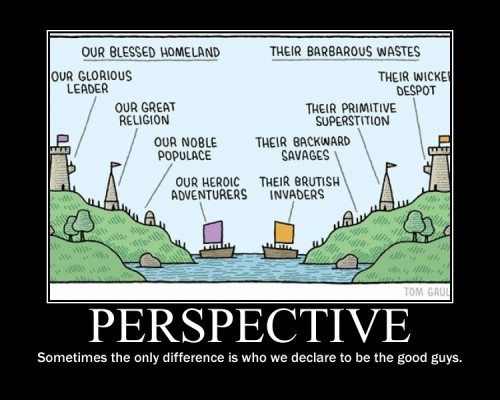
No matter what you call us vs them, you can see that each side is pretty much exactly the same. That what you call them is just a matter of perspective. Is this always true? No, I don't think so. Yet to reasonably say that our side is better, we have to be about something more than just "raison d'etat"
Otherwise, well...a government is a government is a government, and it probably doesn't matter too much who is in charge so long as they make the trains run on time. (Since someone might misunderstand - I'm half joking here. Later on I might go into different economic systems and what they mean, or discuss the development of nationalism, and how little it mattered in earlier time periods. Right now it would be too much of a digression.)
That's enough for now. I still haven't gotten to the heart of our own strategy, but this seems like a good stopping point for now.
How so?
Well...if we say that we should live up to our ideals, then what's to keep us from going around and trying to make everyone else do so as well? "Become a capitalist democratic federal republic or we'll invade!" (Which is essentially what Russia claims we do).
Then there's the problems at a strategic level. Same problem we faced in a counterinsurgency. If you try to be everywhere at once, you're going to be rather weak everywhere. You won't be anywhere in sufficient strength to really make a difference (if your opposition is determined).
It's also the same problem with tackling poverty, I think. If some wealthy philanthropist decided to give all their money away equally, everyone would end up with such a small amount that it wouldn't make a difference. Idealism may be great in theory...but how do you apply it to the real world dilemmas of our time?
How do you apply idealism about human rights, say, consistently? If Russia and China think we're not serious about human rights, it's hard to blame them...we've been so inconsistent. (Though I think they believe human rights is just something we bring up to conceal a more selfish interest, rather than understanding that it's mostly genuine and the only inconsistency is that our realists don't feel it's worth risking our necks over.)
At the same time, idealism is actually pretty important. It what's gives us a future worth fighting for. A future TO fight for. Head in the clouds and unrealistic though idealists may be, their the ones that actually make the world a different (and sometimes better) place. Those who accept the world the way it is and learn to conform, realistic though they may be, are pretty much ensuring that the future is just like the present. In all it's flaws.
Not only that, Jim Collins noted that the corporations that lasted all had a greater purpose than simply 'to make money'. In a similar fashion, I think most people need to feel like their group is about more than selfish survival. That's what I like about this facebook meme:
No matter what you call us vs them, you can see that each side is pretty much exactly the same. That what you call them is just a matter of perspective. Is this always true? No, I don't think so. Yet to reasonably say that our side is better, we have to be about something more than just "raison d'etat"
Otherwise, well...a government is a government is a government, and it probably doesn't matter too much who is in charge so long as they make the trains run on time. (Since someone might misunderstand - I'm half joking here. Later on I might go into different economic systems and what they mean, or discuss the development of nationalism, and how little it mattered in earlier time periods. Right now it would be too much of a digression.)
That's enough for now. I still haven't gotten to the heart of our own strategy, but this seems like a good stopping point for now.
Sunday, October 16, 2016
National Security Musings
The trouble with writing this post is that there are so many choices. I have to weigh various ideas and ask myself 'is this just good to know, or is it critical to our understanding of national security?'
There's a lot out there that is just good to know, particularly with regards to game theory, negotiation, nationalism, economics, technological change, and more.
The first point I want to make, or remake (as I can't emphasize this enough) is that everything is situationally dependent. Getting a clear-eyed view of the situation is over half the problem, especially since there are so many reasons to obscure or hide what's going on.
That said, getting that clear eyed view is a bit like qualitative analysis. That is - quantitative analysis seems solid and reassuring, since it's based on numbers and facts. Find a good sample size, conduct a poll, run some analysis on the results. Maybe get a standard deviation, or regression analysis, or something.
Qualitative analysis can be different. It involves in depth interviews with small groups of people. Yet it's important, as well, because sometimes how we frame the situation determines what we find. You can't create a poll and run statistical analysis if you don't know what questions to ask in the first place, or how to explain a correlation in your findings. Qualitative analysis, then, ideally involves an open-minded and in depth inquiry into a particular situation...which allows you to develop some sort of framework as to what factors are involved, how and why.
Qualitative studies work hand in hand with quantitative, since once you have a theory about what's going on you can create your quantitative studies and do some research to validate your framework. See if the correlations match what you predicted, etc.
In order to get a clear eyed understanding for a national strategy, you have to know what questions to ask in the first place, and how to interpret the answers. (This is why I'm going into those underlying assumptions in more depth.)
Underlying assumptions can encompass anything. Optimist or pessimist? Cooperation or competition? Do we live in a world where every nation is out for itself, or is there room for common ground? Zero sum game, or the opportunity for a win-win?
These things seem very basic, almost not worth mentioning. Yet consider water rights.
When I was in Helmand province, water was a big issue. People who lived upriver could use water freely, and grow crops that required plenty of irrigation. Those downriver, on the other hand, were left to make do with water that was more scarce and sometimes even salty. This limited what crops can grow profitably. (Opium, btw, grows in these conditions well enough that finding an economically comparable alternative for farmers is difficult. Especially since there was apparently a new strain established that used even less water.)
I talked to a hydrologist about the situation, and he insisted that there was enough water for everyone - it's just that everyone had to agree on how to use that water. This is where underlying assumptions come into play. If you think cooperation is possible, if you think other people would abide by an agreement, then it makes sense to get together and negotiate how you're going to use that water.
If, on the other hand, you think agreement is impossible, that everyone is selfish, and that everyone is going to ignore the agreement and get as much water as they can regardless...then there's no point negotiating anything. Get what water you can get, while the getting is good. (This also ties in with game theory, and social dilemmas. Understand that game theory is often based on artificial environments where students or other subjects are asked to respond to various scenarios. It's an interesting field that raises good points about how we actually interact, but be careful about how you apply those findings to the real world.)
So anyways. Applying this to national security - if you think we're capable of creating, implementing, and enforcing an agreement then you will think one way. If, on the other hand, you think it's impossible...you'll choose a completely different set of options. (Consider how this applies to the recent nuclear treaty with Iran).
What I'm personally most interested in, btw, is how you change from one view to another. Or rather, from distrust and opposition to cooperation...the other direction happens all too easily on it's own.
That is, if the hydrologist in Helmand was right and there was plenty of water (if everyone worked together) then how do you convince people to cooperate and support such an agreement? Particularly when their own history and experience shows that such agreement is unlikely?
There's a lot out there that is just good to know, particularly with regards to game theory, negotiation, nationalism, economics, technological change, and more.
The first point I want to make, or remake (as I can't emphasize this enough) is that everything is situationally dependent. Getting a clear-eyed view of the situation is over half the problem, especially since there are so many reasons to obscure or hide what's going on.
That said, getting that clear eyed view is a bit like qualitative analysis. That is - quantitative analysis seems solid and reassuring, since it's based on numbers and facts. Find a good sample size, conduct a poll, run some analysis on the results. Maybe get a standard deviation, or regression analysis, or something.
Qualitative analysis can be different. It involves in depth interviews with small groups of people. Yet it's important, as well, because sometimes how we frame the situation determines what we find. You can't create a poll and run statistical analysis if you don't know what questions to ask in the first place, or how to explain a correlation in your findings. Qualitative analysis, then, ideally involves an open-minded and in depth inquiry into a particular situation...which allows you to develop some sort of framework as to what factors are involved, how and why.
Qualitative studies work hand in hand with quantitative, since once you have a theory about what's going on you can create your quantitative studies and do some research to validate your framework. See if the correlations match what you predicted, etc.
In order to get a clear eyed understanding for a national strategy, you have to know what questions to ask in the first place, and how to interpret the answers. (This is why I'm going into those underlying assumptions in more depth.)
Underlying assumptions can encompass anything. Optimist or pessimist? Cooperation or competition? Do we live in a world where every nation is out for itself, or is there room for common ground? Zero sum game, or the opportunity for a win-win?
These things seem very basic, almost not worth mentioning. Yet consider water rights.
When I was in Helmand province, water was a big issue. People who lived upriver could use water freely, and grow crops that required plenty of irrigation. Those downriver, on the other hand, were left to make do with water that was more scarce and sometimes even salty. This limited what crops can grow profitably. (Opium, btw, grows in these conditions well enough that finding an economically comparable alternative for farmers is difficult. Especially since there was apparently a new strain established that used even less water.)
I talked to a hydrologist about the situation, and he insisted that there was enough water for everyone - it's just that everyone had to agree on how to use that water. This is where underlying assumptions come into play. If you think cooperation is possible, if you think other people would abide by an agreement, then it makes sense to get together and negotiate how you're going to use that water.
If, on the other hand, you think agreement is impossible, that everyone is selfish, and that everyone is going to ignore the agreement and get as much water as they can regardless...then there's no point negotiating anything. Get what water you can get, while the getting is good. (This also ties in with game theory, and social dilemmas. Understand that game theory is often based on artificial environments where students or other subjects are asked to respond to various scenarios. It's an interesting field that raises good points about how we actually interact, but be careful about how you apply those findings to the real world.)
So anyways. Applying this to national security - if you think we're capable of creating, implementing, and enforcing an agreement then you will think one way. If, on the other hand, you think it's impossible...you'll choose a completely different set of options. (Consider how this applies to the recent nuclear treaty with Iran).
What I'm personally most interested in, btw, is how you change from one view to another. Or rather, from distrust and opposition to cooperation...the other direction happens all too easily on it's own.
That is, if the hydrologist in Helmand was right and there was plenty of water (if everyone worked together) then how do you convince people to cooperate and support such an agreement? Particularly when their own history and experience shows that such agreement is unlikely?
Saturday, October 15, 2016
National Security, Current and Historical Events
Due to current events, I've been rethinking how I was going to write my next few posts. It seems that (much though I was planning to avoid it) I actually have to write about some of my underlying thought processes.
Take the current situation with Russa, regarding Syria and the US elections. There are some Americans arguing that we need to be firm, that Russia sees anything less as a sign of weakness and will keep pushing unless or until we do stand firm. Others see the potential for the situation to escalate out of hand, and do not think we should risk starting World War III over Syria.
Historically, there's merit to both arguments. For a while there, some Americans thought Saddam Hussein misinterpreted a discussion with our State Dept as an indication that the US would do nothing if he invaded Kuwait. (Reading up on it now, clearly more information has developed since I heard about this in college...and it looks like this isn't actually what happened.)
On the flip side, historians say that Germany helped create the conditions for World War I because they had lost almost all their allies except Austria, and so had to demonstrate their firm commitment to their ally...which helped expand what could have been a much more local conflict into something global. (Otto van Bismarck allegedly believed that Germany was at risk of encirclement, and worked hard to maintain good relations with his neighbors. Kaiser Wilhelm wasn't quite so adept at foreign policy, and managed to alienate almost everyone.)
Given the articles I posted a couple of days ago, I decided to check around a bit online. One article said that Russia had to support Assad, because if Assad is overthrown then Iran is the only ally they have left in the region.
What's funny is that this article is discussing the decline of Russian influence (and paints the support for Assad as a sign of that weakness, much like Germany supporting Austria), whereas a lot of other articles are basically saying that Russia is standing strong and making the United States look weak and ineffective.
I don't know enough about the situation to say what's truly going on, unfortunately. It seems like there are two (or more) ways of analyzing the situation, and the recommended course of action for one scenario is the absolutely worst thing you could do if the second is closer to reality. And vice versa.
Anyways. The point of this post was to say I'm changing up what I was going to write about. I planned to discuss our relationship with Iran - I don't think anyone can say that our policies towards Iran have made us more secure over the past thirty or forty decades. Our involvement with the Iranian coup in 1953 was a factor in our hostile relations since the revolution. What's funny is that according to Wilsonian ideals we should never have done gotten involved like that.
Were the American individuals who supported the coup the realists? Or should they have expected and predicted the backlash we received? After all, we were once a colony ourselves. We fought our own revolution against imperial rule. If any great nation should have understood how resentful a nation can be when outside powers appear to be in control, it was the United States.
(What's funny is I came across an article that had the exact opposite take on Iran. That it wasn't our heavy-handedness in installing the Shah that hurt, so much as our making the Shah weak by pressuring him to liberalize. I didn't find the source very credible, especially considering they claim the West instigated the revolution against the Shah as well. I think the United States lost out too much to justify that theory...but I'm including it because I wanted to highlight how completely different historical analysis can be. FYI - the source has ties to the John Birch society, and I felt the article drew on the all too common 'realist' notion that ideals make us weak.)
Instead of delving into these topics more deeply, I'm considering what underlying beliefs are necessary to create a sound national security policy. I don't have anything solid yet, so I'll either wait until the ideas develop more or start writing a stream-of-consciousness type post to see what bubbles up. Haven't decided yet.
Take the current situation with Russa, regarding Syria and the US elections. There are some Americans arguing that we need to be firm, that Russia sees anything less as a sign of weakness and will keep pushing unless or until we do stand firm. Others see the potential for the situation to escalate out of hand, and do not think we should risk starting World War III over Syria.
Historically, there's merit to both arguments. For a while there, some Americans thought Saddam Hussein misinterpreted a discussion with our State Dept as an indication that the US would do nothing if he invaded Kuwait. (Reading up on it now, clearly more information has developed since I heard about this in college...and it looks like this isn't actually what happened.)
On the flip side, historians say that Germany helped create the conditions for World War I because they had lost almost all their allies except Austria, and so had to demonstrate their firm commitment to their ally...which helped expand what could have been a much more local conflict into something global. (Otto van Bismarck allegedly believed that Germany was at risk of encirclement, and worked hard to maintain good relations with his neighbors. Kaiser Wilhelm wasn't quite so adept at foreign policy, and managed to alienate almost everyone.)
Given the articles I posted a couple of days ago, I decided to check around a bit online. One article said that Russia had to support Assad, because if Assad is overthrown then Iran is the only ally they have left in the region.
What's funny is that this article is discussing the decline of Russian influence (and paints the support for Assad as a sign of that weakness, much like Germany supporting Austria), whereas a lot of other articles are basically saying that Russia is standing strong and making the United States look weak and ineffective.
I don't know enough about the situation to say what's truly going on, unfortunately. It seems like there are two (or more) ways of analyzing the situation, and the recommended course of action for one scenario is the absolutely worst thing you could do if the second is closer to reality. And vice versa.
Anyways. The point of this post was to say I'm changing up what I was going to write about. I planned to discuss our relationship with Iran - I don't think anyone can say that our policies towards Iran have made us more secure over the past thirty or forty decades. Our involvement with the Iranian coup in 1953 was a factor in our hostile relations since the revolution. What's funny is that according to Wilsonian ideals we should never have done gotten involved like that.
Were the American individuals who supported the coup the realists? Or should they have expected and predicted the backlash we received? After all, we were once a colony ourselves. We fought our own revolution against imperial rule. If any great nation should have understood how resentful a nation can be when outside powers appear to be in control, it was the United States.
(What's funny is I came across an article that had the exact opposite take on Iran. That it wasn't our heavy-handedness in installing the Shah that hurt, so much as our making the Shah weak by pressuring him to liberalize. I didn't find the source very credible, especially considering they claim the West instigated the revolution against the Shah as well. I think the United States lost out too much to justify that theory...but I'm including it because I wanted to highlight how completely different historical analysis can be. FYI - the source has ties to the John Birch society, and I felt the article drew on the all too common 'realist' notion that ideals make us weak.)
Instead of delving into these topics more deeply, I'm considering what underlying beliefs are necessary to create a sound national security policy. I don't have anything solid yet, so I'll either wait until the ideas develop more or start writing a stream-of-consciousness type post to see what bubbles up. Haven't decided yet.
Wednesday, October 12, 2016
Speaking of Signals
This is pretty ominous.
http://www.dailystar.co.uk/news/latest-news/552839/russia-recalls-officials-deputies-family-children-abroad-return-fatherland-ww3-world-war-3
I won't speculate further, as I know there's information I don't have, w/regards to what's going on.
Tuesday, October 11, 2016
Realism and Vietnam
So. Vietnam.
While looking up articles to support this post I came across this one, which nicely sums up three of the views I knew of (the Vietnam War was a crime, the Vietnam War was justified and we were betrayed on the homefront, and that the Vietnam War was a tragic mistake brought about by U.S. leaders who exaggerated the influence of communism and underestimated the power of nationalism)...and added a fourth I hadn't heard of before. This article makes it clear why I support the third view. As for the new fourth one, I'm not sure I buy it. Sure, after the fact it seems to make sense of what was going on. For the thought processes at the time, though, it doesn't touch on a key argument used to support our involvement in Vietnam.
Namely domino theory. The belief that if one nation fell to communists, all the neighboring nations would also fall. The Wikipedia article linked above gives the evidence both in favor and against this theory. Unsurprisingly, I'm most persuaded by the fact that Thailand, Indonesia, and other large Southeast Asian countries didn't fall after the 1975 end of the Vietnam War. My opinion was probably also shaped by the fall of the Berlin Wall, which really made the communist threat seem overblown.
With regards to nationalism, it definitely seemed more important than communism in shaping Vietnamese resistance. Ho Chi Minh's biography again sums up what I learned in college, particularly this bit:
He [Ho Chi Minh] joined a group of Vietnamese nationalists in Paris whose leaders were Phan Chu Trinh and Phan Văn Trường. They had been publishing newspaper articles advocating for Vietnamese independence...Following World War I, the group petitioned for recognition of the civil rights of the Vietnamese people in French Indochina to the Western powers at the Versailles peace talks, but was ignored. Citing the language and the spirit of the U.S. Declaration of Independence, they expected U.S. President Woodrow Wilson to help remove the French colonial rule from Vietnam and ensure the formation of a new, nationalist government.
Our feared enemy cited our own Declaration of Independence and the Wilsonian ideals of self-determination...and became further radicalized when we failed to live up to those ideals.
You could almost say we lost our power and influence because we gave up on an idealistic foreign policy. Almost. I'm too much of a classic realist to go that far. (I really liked Hans Morgenthau's work, though I think I was a classic realist before I read Politics Among Nations).
One more thing. No institution is monolithic. Building up the communist opposition meant acting as though China and the Soviet Union were a single communist entity. That's part of the genius behind Nixon's visit to China. I am not entirely sure it was wise in the long run given current events, but I do think it's a better strategy than letting your imagination create a threat that isn't quite as perfect as we built it up to be.
I suppose it's a bit like diamonds - they all have fractures, though some have less than others. An expert may figure out where to tap the diamond to fracture it entirely...
While looking up articles to support this post I came across this one, which nicely sums up three of the views I knew of (the Vietnam War was a crime, the Vietnam War was justified and we were betrayed on the homefront, and that the Vietnam War was a tragic mistake brought about by U.S. leaders who exaggerated the influence of communism and underestimated the power of nationalism)...and added a fourth I hadn't heard of before. This article makes it clear why I support the third view. As for the new fourth one, I'm not sure I buy it. Sure, after the fact it seems to make sense of what was going on. For the thought processes at the time, though, it doesn't touch on a key argument used to support our involvement in Vietnam.
Namely domino theory. The belief that if one nation fell to communists, all the neighboring nations would also fall. The Wikipedia article linked above gives the evidence both in favor and against this theory. Unsurprisingly, I'm most persuaded by the fact that Thailand, Indonesia, and other large Southeast Asian countries didn't fall after the 1975 end of the Vietnam War. My opinion was probably also shaped by the fall of the Berlin Wall, which really made the communist threat seem overblown.
With regards to nationalism, it definitely seemed more important than communism in shaping Vietnamese resistance. Ho Chi Minh's biography again sums up what I learned in college, particularly this bit:
He [Ho Chi Minh] joined a group of Vietnamese nationalists in Paris whose leaders were Phan Chu Trinh and Phan Văn Trường. They had been publishing newspaper articles advocating for Vietnamese independence...Following World War I, the group petitioned for recognition of the civil rights of the Vietnamese people in French Indochina to the Western powers at the Versailles peace talks, but was ignored. Citing the language and the spirit of the U.S. Declaration of Independence, they expected U.S. President Woodrow Wilson to help remove the French colonial rule from Vietnam and ensure the formation of a new, nationalist government.
Our feared enemy cited our own Declaration of Independence and the Wilsonian ideals of self-determination...and became further radicalized when we failed to live up to those ideals.
You could almost say we lost our power and influence because we gave up on an idealistic foreign policy. Almost. I'm too much of a classic realist to go that far. (I really liked Hans Morgenthau's work, though I think I was a classic realist before I read Politics Among Nations).
One more thing. No institution is monolithic. Building up the communist opposition meant acting as though China and the Soviet Union were a single communist entity. That's part of the genius behind Nixon's visit to China. I am not entirely sure it was wise in the long run given current events, but I do think it's a better strategy than letting your imagination create a threat that isn't quite as perfect as we built it up to be.
I suppose it's a bit like diamonds - they all have fractures, though some have less than others. An expert may figure out where to tap the diamond to fracture it entirely...
Friday, October 7, 2016
Raison d'Etat
Foreign policy experts, for the most part, focus on realism (though one person's realism is not the same as another). There's a peculiar sort of logic to it, in that experts are not concerned with what is morally right or wrong...the only true test is whether or not you achieve your aims. On behalf of your nation.
I deliberately made that a little vague. Most of those aims are, to be sure, to make your own nation strong and prosperous. Or secure. Or somesuch. All are nicely covered by saying "achieve your aims".
That's part of why figures like Cardinal Richelieu and Otto von Bismarck are such complex and fascinating characters. Not saints, no. Yet masters of their time, and mostly in service to their state. (For good or ill).
It's hard to judge characters like this, as they are definitely not 'nice', or 'good', or necessarily people we should admire or want to follow. They managed to do great things, though.
I brought this up because if we're using Raison d'Etat, or realpolitik, or some other form of realism to determine our own policies than (using that logic) the only way to judge the decisions made is by their results.
It's a harsh method, one that allows no wiggle room for error. Nor for good intentions.
And by that rubric, American policy in the last 60 or 70 years has not been all that great.
Yes, we saw the end of the Soviet Union. Yes, we're a very powerful nation. Our policies haven't been a complete disaster, though how much of that is because of our innate strengths I don't know. We're a large country, with fairly secure borders (comparatively speaking), a well educated populace and a lot of resources. We're also dealing with all sorts of turmoil and change. Globalization, the Information Age, nationalism, multi-nationalist corporations, environmental change...there's been all sorts of challenges. People have been doing the best they know how, and this isn't meant to point fingers and condemn anyone.
At the same time, can anyone look at Vietnam and say that the United States came out of it stronger? Can anyone look at our history with Iran and think we're safer, or more secure?
Can anyone look at the financial crisis, the recession, Syria, rising tensions in the South China sea, tensions with Russia and China (and the Philippines) and think we've been doing well?
Again, I'm not trying to call anyone in particular out. It's just...
It's just that foreign policy, national security, and the Washington consensus has fads. Just like businesses, and fashion, and just about everything else. People aren't ever going to be thrown under the bus for being wrong, if everyone else was wrong too. So even though 'nobody' saw the fall of the Soviet Union coming when it did (as one example) nobody was going to be penalized for that failure. After all, everyone made the same mistake.
And nobody was going to be penalized for failing to predict the financial crisis, since hardly anybody credible saw it coming.
Again, this is hard to do. Like predicting 9/11. Once you know something happened you can go back and pick through the pieces, figure out which clues foreshadowed the event. But figuring it out in real time? Sorting out those pieces, putting them together with the other pieces, and figuring it out in time to actually act on it?
Very, very hard.
And something that's absolutely essential.
I deliberately made that a little vague. Most of those aims are, to be sure, to make your own nation strong and prosperous. Or secure. Or somesuch. All are nicely covered by saying "achieve your aims".
That's part of why figures like Cardinal Richelieu and Otto von Bismarck are such complex and fascinating characters. Not saints, no. Yet masters of their time, and mostly in service to their state. (For good or ill).
It's hard to judge characters like this, as they are definitely not 'nice', or 'good', or necessarily people we should admire or want to follow. They managed to do great things, though.
I brought this up because if we're using Raison d'Etat, or realpolitik, or some other form of realism to determine our own policies than (using that logic) the only way to judge the decisions made is by their results.
It's a harsh method, one that allows no wiggle room for error. Nor for good intentions.
And by that rubric, American policy in the last 60 or 70 years has not been all that great.
Yes, we saw the end of the Soviet Union. Yes, we're a very powerful nation. Our policies haven't been a complete disaster, though how much of that is because of our innate strengths I don't know. We're a large country, with fairly secure borders (comparatively speaking), a well educated populace and a lot of resources. We're also dealing with all sorts of turmoil and change. Globalization, the Information Age, nationalism, multi-nationalist corporations, environmental change...there's been all sorts of challenges. People have been doing the best they know how, and this isn't meant to point fingers and condemn anyone.
At the same time, can anyone look at Vietnam and say that the United States came out of it stronger? Can anyone look at our history with Iran and think we're safer, or more secure?
Can anyone look at the financial crisis, the recession, Syria, rising tensions in the South China sea, tensions with Russia and China (and the Philippines) and think we've been doing well?
Again, I'm not trying to call anyone in particular out. It's just...
It's just that foreign policy, national security, and the Washington consensus has fads. Just like businesses, and fashion, and just about everything else. People aren't ever going to be thrown under the bus for being wrong, if everyone else was wrong too. So even though 'nobody' saw the fall of the Soviet Union coming when it did (as one example) nobody was going to be penalized for that failure. After all, everyone made the same mistake.
And nobody was going to be penalized for failing to predict the financial crisis, since hardly anybody credible saw it coming.
Again, this is hard to do. Like predicting 9/11. Once you know something happened you can go back and pick through the pieces, figure out which clues foreshadowed the event. But figuring it out in real time? Sorting out those pieces, putting them together with the other pieces, and figuring it out in time to actually act on it?
Very, very hard.
And something that's absolutely essential.
Subscribe to:
Posts (Atom)